Cleaning Tips
Bathroom Cleaning: A St. Louis Home Checklist
Clean your bathroom in a sensible order, protect grout and stone, and avoid common disinfecting mistakes with this practical St. Louis home checklist.
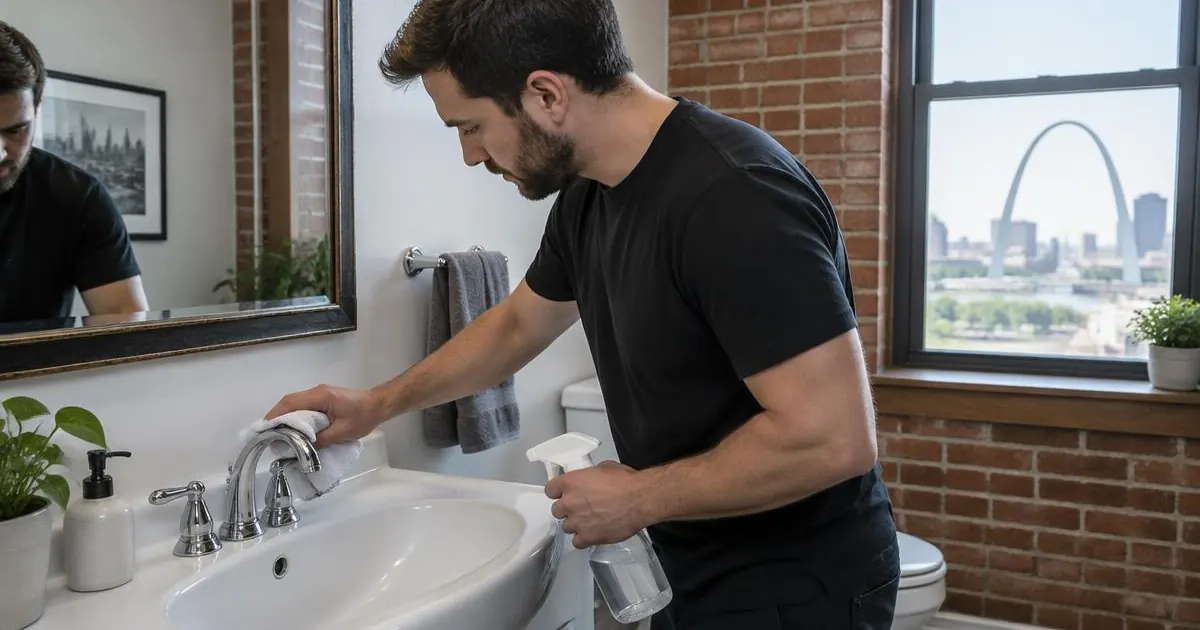
Your bathroom cleaning checklist for St. Louis homes
Use this bathroom cleaning checklist for St. Louis homes in this order: ventilate, clear surfaces, remove loose dust, clean the shower and tub, wash the sink and vanity, clean the toilet, then finish the floor. Disinfect selected surfaces only when appropriate, after cleaning them. Check both the product label and the surface manufacturer’s care instructions before starting.
Set out gloves, separate toilet-cleaning tools, clean cloths, a nonabrasive brush, a floor tool, and products suited to your finishes. Keep labels available rather than transferring products into unidentified bottles. Move towels, bath mats, toiletries, and wastebaskets out of the working area.
In an older St. Louis brick home, a remodeled bathroom may combine original tile with newer stone, coated fixtures, and replacement grout. Do not assume one spray suits every surface. If you cannot identify a material, start with the manufacturer’s guidance or ask before using a stain remover.
By Prime Cleaning MO Team.
Start with ventilation and a realistic moisture check
Turn on the bathroom exhaust fan before cleaning and follow any ventilation directions on the product label. Open a window when weather, outdoor conditions, and security allow. Keep children and pets out of the workspace, and avoid spraying products toward your face or into the air.
Check the fan grille for visible dust. With the fan switched off, clean accessible exterior surfaces according to the manufacturer’s instructions; do not spray liquid into the assembly. A fan that runs but leaves persistent condensation deserves attention beyond wiping its cover.
After bathing or cleaning, remove standing water and allow wet surfaces to dry. If a bath mat stays damp underneath, hang it to dry rather than returning it immediately. Recurring moisture around a toilet base, under a vanity, or along a tub seam calls for leak investigation.
Repeated discoloration on damp caulk is not a reason to keep applying stronger chemicals. Address the moisture source and seek an appropriate assessment if growth is extensive, keeps returning, or involves damaged materials.
Explore our cleaning tips service and cleaning in St. Louis, MO for property-specific information.
Remove loose soil before washing surfaces
Work from higher surfaces toward the floor. Dust accessible shelves, ledges, the top of the mirror frame, and baseboards with a tool that captures rather than scatters debris. Leave light fixtures alone unless they are off, cool, and safely reachable. Never stand on a toilet or tub edge.
Pick up hair around the toilet, vanity, and drain before adding water. Otherwise, it becomes harder to collect and tends to migrate onto freshly cleaned surfaces. Empty the wastebasket and clean it with a compatible product if residue remains.
Clean mirrors with a finish-compatible product applied to a cloth when the instructions allow. Avoid saturating frame edges or letting liquid seep behind the mirror. Use a fresh cloth for the vanity rather than one already used on dusty trim.
This first pass also reveals what needs special attention: a chalky faucet deposit, a greasy ring around the tub, or crumbling grout. Treat each as a separate problem instead of coating the whole room with a stronger cleaner.
Clean showers, grout, and stone without causing damage
Identify the shower wall, tub, grout, and fixture finishes before choosing products. Apply a compatible cleaner as directed, allow its specified working time, agitate gently, and rinse if instructed. Keep products from drying on surfaces unless the label specifically directs otherwise.
Use gentle tools on grout and caulk
For intact grout, begin with a manufacturer-approved cleaner and a soft nylon brush. Focus on joints where residue collects, then rinse away loosened soil. Avoid metal brushes and aggressive scraping, which can damage joints and nearby finishes.
If grout is loose or caulk is separating, stop scrubbing that area and arrange repair. Cleaning cannot restore a failed joint. Likewise, discoloration beneath clear caulk may not be removable from the surface; repeated chemical treatments are not a substitute for checking its condition.
Separate mineral removal from stone care
Do not use acids, including vinegar and acidic descalers, on marble. A product that removes deposits from approved ceramic tile may etch nearby stone or damage a fixture coating. Use stone-specific, manufacturer-approved care and protect adjacent materials from runoff.
For example, if a shower has ceramic walls but a marble threshold, do not spray the entire enclosure with a mineral remover. Choose a method safe for the whole assembly or seek material-specific advice. Test compatible products in an inconspicuous spot, but remember that testing does not override a manufacturer’s restriction.
Handle the sink, vanity, and toilet as separate zones
Wash the sink and counter with a suitable cleaner, paying attention to the faucet base and the area behind soap dispensers. Remove residue around the drain without forcing debris down it. Dry coated fixtures with a soft cloth if their care instructions recommend it.
Wipe cabinet fronts and handles using minimal moisture, especially near seams and exposed wood. Do not soak vanity edges or hinges. Emptying a cabinet and checking for leaks is different from simply wiping its exterior; decide whether interior cleaning belongs in today’s task.
Keep toilet tools separate from sink and shower tools. Clean the flush handle, lid, seat, hinges, exterior bowl, and base, moving from less soiled areas toward more soiled areas and changing cloths as needed. Use a toilet-bowl product only where its label permits.
Never mix cleaners, including bleach with acids, ammonia, or other cleaning products. Do not add another chemical to a bowl containing a previous product. Follow label directions for use, rinsing, and safe handling.
Disinfect selectively and respect label contact time
Cleaning removes dirt and residue; disinfecting is a separate step. CDC guidance calls for cleaning before disinfection and using disinfection when appropriate. Routine bathroom care does not require treating every wall, cabinet, and floor surface with disinfectant.
When disinfection is appropriate, choose a product labeled for the intended surface and use. Read its dilution, protective-equipment, ventilation, application, and rinsing instructions. A product suitable for a toilet exterior may not be suitable for natural stone or unfinished wood.
EPA guidance emphasizes keeping the treated surface visibly wet for the full label contact time. There is no universal number of minutes. Use the time on your specific product label, not a remembered rule from another bottle.
For example, wiping a flush handle immediately after spraying may remove the product before its required contact time is complete. Clean first, apply as directed, and monitor wetness throughout that time. If the surface dries early, follow the label’s directions rather than assuming the job is finished.
Finish the floor and build a manageable routine
Once higher surfaces are finished, collect any remaining hair and debris from the floor. Clean with a product approved for that flooring, using no more moisture than its care instructions allow. Work toward the doorway and keep the floor clear until it is dry.
Return only dry, clean items. Wash towels and bath mats according to their care labels, and let cleaning tools dry before storage. Keep toilet brushes and cloths separate from tools used elsewhere.
Between full cleanings, remove splashes, hang damp textiles, and clear visible hair. Adjust your routine to actual use: a shared bathroom may need attention sooner than a rarely used guest bath. If soap film is accumulating despite regular wiping, review product compatibility and technique before increasing chemical strength.
Choose professional help based on the bathroom’s condition
When buildup has outpaced maintenance, ask Prime Cleaning MO LLC about an initial deep clean in the St. Louis metro. Describe the bathroom count, visible buildup, surface materials, and access concerns. Photos can help communicate details, but flag leaks, damaged grout, and unidentified stains separately.
A standard or recurring-service quote includes the required initial deep clean. Standard or recurring cleaning is available only after that initial deep clean, not as a one-time service or for first-time clients. Detailed work may take more than one day; scope and condition matter.
For deep cleaning, appliance interiors and inside cabinets are optional add-ons. If you want the bathroom vanity interior cleaned, request it explicitly. Interior windows are also an add-on for residential services; mention bathroom glass and access restrictions when discussing the scope. Agree on priorities rather than assuming every detailed task is included.