House Cleaning
House Cleaning Kirkwood: Kitchen Clearance and Interior Add-Ons
A successful first cleaning starts with accessible kitchen surfaces and a clear agreement about appliance interiors. Here is what to prepare and what to discuss.

house cleaning Kirkwood: Kitchen Clearance and Interior Add-Ons
Your first cleaning visit is easier to plan when the kitchen’s working surfaces are accessible and everyone understands what will be cleaned. If you are comparing house cleaning Kirkwood options, start with two decisions: what you can move off the counters and whether you want any appliance interiors cleaned. Those choices help distinguish ordinary preparation from additional cleaning work that needs its own scope.
For your first visit with Prime Cleaning MO LLC, explain your priorities rather than trying to make the house look freshly cleaned. A counter crowded with coffee equipment needs a different plan from an empty counter with sticky buildup. You do not need to scrub before the team arrives; you do need to identify delicate surfaces, decide where loose belongings belong, and clarify which closed spaces may be opened. This guide focuses on those practical decisions, especially the appliance work that is not automatically part of a deep clean.
Clear counters without turning preparation into another cleaning job
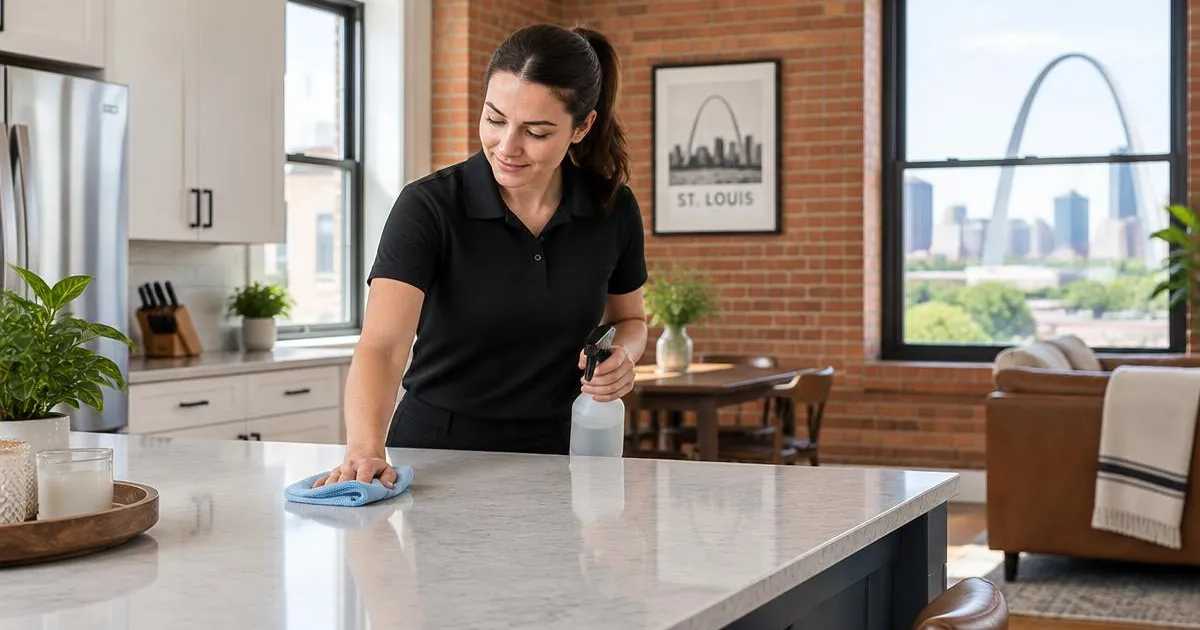
Work across the kitchen one area at a time. Put food away, gather mail into a container, and relocate medication, cash, keys, and fragile decorations to a place that will not need cleaning. Deal with dirty dishes or ask beforehand whether dish handling can be included. Do not assume a sink full of dishes will be washed as part of the agreed visit.
Move lightweight items only when you can do so comfortably. Leave heavy mixers, attached equipment, and anything with awkward cords in place, then identify them during intake. Ask whether the team can clean around an item or whether you should arrange help moving it. Cleaning beneath a heavy appliance should never depend on an unspoken expectation.
Aim for accessible stretches of counter, not a showroom. For example, placing loose tea bags and utensils in a labeled basket can open the coffee area without reorganizing the whole kitchen. Keep that basket somewhere outside the agreed cleaning areas so it does not simply transfer the obstruction.
Explore our house cleaning service and cleaning in Kirkwood, MO for property-specific information.
Choose appliance interiors before the visit
With a deep clean, appliance interiors and inside cabinets are optional add-ons. Request them explicitly rather than treating “clean the kitchen” as permission to open and clean every enclosed space. Name each appliance, describe its condition, and ask what preparation is required. This makes the quote more useful and prevents exterior cleaning from being confused with interior detailing.
Refrigerator and freezer decisions
Explain whether the refrigerator will be empty, partly stocked, or full. Ask who will remove food and detachable parts, and arrange suitable storage for perishables if emptying is required. Flag cracked shelves, loose trim, or controls that should not be disturbed. Freezer work also needs a separate discussion; do not unplug or defrost equipment unless the agreed procedure and manufacturer instructions call for it.
Ovens and other enclosed appliances
Identify the oven type and describe visible grease or baked-on residue. Ask whether racks are included in the requested add-on and disclose any coating or cleaning restrictions. Do not start a self-cleaning cycle as routine preparation. For microwaves, dishwashers, or other appliances, name the interior you want addressed and confirm whether that task is available within the proposed scope.
Share surface-care information before products are selected
Kitchen surfaces can look similar while requiring different care. Tell the team whether your counters are natural stone, engineered material, wood, laminate, or unknown. Mention recently installed finishes, resealed stone, painted cabinets, and appliance coatings. Share manufacturer instructions when available, particularly restrictions on moisture, abrasives, or chemical products.
Follow manufacturer cure times for new sealants, paint, grout, and other finishes rather than assuming they are ready because they feel dry. If you cannot identify a surface or its care requirements, flag that uncertainty before cleaning begins. Avoid acids on stone, and never mix cleaners or leave unlabeled chemical mixtures for the team.
Disinfection is a separate decision from removing crumbs, grease, and residue. It should be used only when appropriate for the task and surface, with the full product-label contact time. Describe the concern you want addressed instead of requesting stronger chemicals everywhere; suitable methods matter more than intensity.
Explain priorities, access, and household boundaries
During intake, describe the kitchen alongside the rest of the home so the work can be planned realistically. Share the number of bedrooms and bathrooms, current condition, and the rooms you want included. Identify your highest-priority outcomes: accessible counters, a greasy cooking area, or an optional refrigerator interior. If priorities compete, ask what can fit within the agreed scope rather than assuming everything is interchangeable.
Provide entry instructions and explain where pets will stay. Point out rooms that are off limits, sensitive belongings, and any household member who will be working or resting during the visit. Keep walkways open so equipment can be brought in without navigating piles of boxes.
Discuss what should happen if an unexpected issue appears. For example, a cabinet shelf with a loose support needs a note and a scope conversation, not an expectation that the cleaner will repair it. Finish repairs and appliance servicing are not cleaning tasks.
Match the service to the home’s actual situation
A first visit should not be booked as a one-time standard clean. Standard or recurring service with Prime Cleaning MO LLC is available only after an initial deep clean, and the first standard/recurring quote includes that deep clean. For an occupied kitchen needing a reset, discuss deep cleaning and select any appliance-interior or inside-cabinet add-ons separately.
Move-In/Move-Out cleaning has a different scope: it includes inside and outside cabinets and appliances. Explain whether the property will be empty and whether food or belongings remain in those spaces. Do not assume that inclusion applies to an occupied-home deep clean simply because you are rearranging the kitchen.
Interior windows are optional add-ons for these services, not automatic inclusions; the optional-add-on rule does not apply to Airbnb turnovers. If your request involves detailed work beyond deep cleaning, ask how it will be organized. That level of detailing may take more than one day, so avoid planning around an assumed single-visit completion.
Flag renovation dust and business properties before booking
If kitchen preparation follows remodeling, say so before requesting ordinary house cleaning. Residential construction intake should cover bedrooms, bathrooms, and condition: debris, dust, or more extensive residue. Explain which rooms were affected and whether construction has finished. Heavy debris removal and hauling must be scoped separately from cleaning surfaces.
If dust is unknown or potentially hazardous, stop and request assessment by a qualified contractor before cleaning proceeds. Do not sweep it through the home or use a household vacuum for construction dust. Cleaning should not be presented as asbestos, lead, silica, or mold remediation, hazardous-waste removal, duct cleaning, or a guarantee of occupancy safety.
For a business property rather than a residence, the booking process changes. Commercial/industrial cleaning and commercial post-construction cleaning require a free in-person walkthrough before pricing. Provide the business name, approximate square footage, restroom count, preferred date/time window, and onsite contact. Hazardous work should never be assumed available as an extension of ordinary cleaning.
Use a final scope check instead of a last-minute scramble
Before the visit, compare your preparation with the agreed request. Are counters accessible? Have you named the appliance interiors you want cleaned? Are cabinets included under your service or selected as add-ons? Have you shared surface restrictions and made a plan for food, pets, and access? Resolve unclear answers before the team begins.
Leave a short note for anything easy to overlook, such as a loose refrigerator shelf or a countertop awaiting full cure. Avoid adding major tasks at arrival without discussing how they affect the scope. The goal is not to prepare a universally perfect kitchen; it is to make your priorities visible and the requested work practical. Clear counters and explicit interior-cleaning decisions give the first visit a focused starting point.