House Cleaning
House Cleaning Maplewood: Clutter Versus Cleaning Tasks
A small home does not need to be perfectly organized before a cleaning visit. Learn what to move, what to leave, and how to set priorities for your first appointment.
house cleaning Maplewood: Clutter Versus Cleaning Tasks
Preparing for house cleaning Maplewood starts with a practical distinction: you make belongings manageable, and the cleaning team addresses the agreed surfaces. In a small home, a few shoes, laundry baskets, or countertop appliances can block a large share of the available workspace. You do not need to scrub the bathroom before someone arrives. The useful preparation is deciding where personal items belong and explaining what needs attention.
For your first visit with Prime Cleaning MO LLC, think in terms of access rather than appearances. Can someone reach the bathroom sink, follow a clear path around the bed, and clean the kitchen counter without sorting private belongings? Those questions matter more than whether your home looks ready for company. Start with the room that causes the most daily frustration, then identify the items that prevent it from being cleaned. This keeps preparation focused instead of turning it into an exhausting whole-home organizing project.
Separate clutter decisions from cleaning responsibilities
Clutter requires decisions about ownership, storage, and disposal. Cleaning addresses dirt and buildup on agreed surfaces. A stack of mail needs your judgment; the accessible tabletop underneath needs cleaning. A shower full of personal bottles needs a storage decision before its surfaces are readily accessible. Do not assume cleaners will decide what to discard, reorganize drawers, or find permanent homes for loose items.
What you should handle before arrival
Put away cash, jewelry, medication, confidential papers, and fragile keepsakes. Gather loose clothing and explain where ordinary trash should go. Keep donation bags separate from rubbish so useful belongings are not mistaken for waste. If something must stay in place, identify it rather than relying on a cleaner to guess.
What to discuss with the cleaning team
Ask whether limited item movement is included and what will happen where belongings remain. For example, a crowded desk might receive cleaning only on exposed areas, while a cleared dining table can receive broader surface attention. Confirm any organizing or lifting requests separately; they are not automatically part of cleaning.
Explore our house cleaning service and cleaning in Maplewood, MO for property-specific information.
Create access when storage space is limited
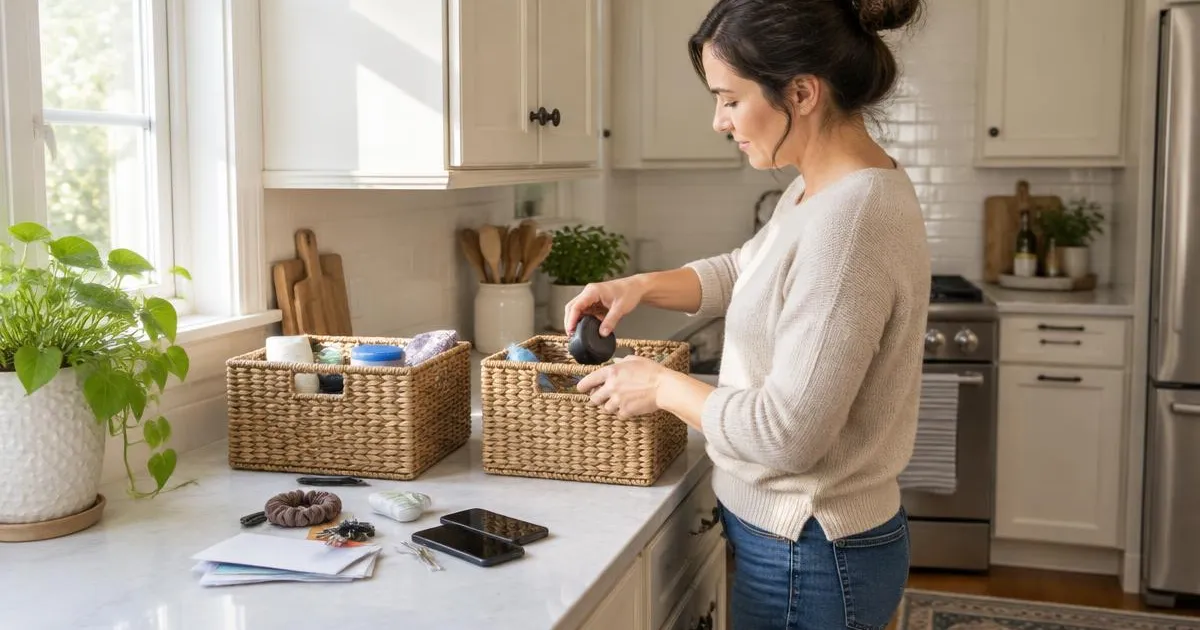
In a compact home, moving everything into another room can simply transfer the obstacle. Instead, use a few contained holding spots that leave walkways, doors, and work areas clear. Put everyday bathroom items in a portable basket, gather loose toys in one container, and place shoes together outside the main cleaning path. Avoid piling belongings onto furniture you want cleaned.
Work through the home in this order: establish safe walking access, expose priority surfaces, then address less important clutter. Keep cords and pet items out of the route where practical. Do not move heavy furniture or unstable stacks just to prepare for the visit; explain those limitations in advance.
Choose between competing priorities realistically. If your kitchen table must hold work equipment, ask for cleaning around that setup rather than expecting full access. If bathroom buildup matters more, clear that room thoroughly. Tell the team which surfaces will remain blocked so the proposed scope reflects the actual working space.
Choose the first-visit service by condition and purpose
For a lived-in home, describe the present condition rather than requesting the shortest service name. Mention kitchen grease, bathroom buildup, pet hair, and rooms that have gone without detailed attention. Standard or recurring cleaning with Prime Cleaning MO LLC begins only after an initial deep clean; it is not a first-time or one-time service. Your first standard or recurring quote includes that initial deep clean.
For deep cleaning, appliance interiors and inside cabinets are optional add-ons. Ask for them explicitly if crumbs inside drawers or residue inside an oven are priorities. Interior windows are also optional for house-cleaning services, not automatic inclusions. Provide the number and accessibility of the windows you want considered.
If the appointment is genuinely for moving in or out, that service includes inside and outside cabinets and appliances. Explain whether those spaces will be empty and accessible. A furnished, occupied home with extensive belongings is a different access problem from a vacant move-out, even when the bedroom count matches.
Give an intake description that supports useful decisions
Start with your bedroom and bathroom counts, approximate home size, occupancy, and current condition. Then describe the clutter that affects access: a bedroom used for storage, crowded kitchen counters, or laundry covering part of the floor. Photos, if requested, can clarify access without requiring you to stage the home. Avoid including sensitive documents or personal information in them.
Offer ranked priorities rather than saying everything needs attention. For example: “The bathroom and kitchen matter most. The spare room is storage, and I only want its accessible floor considered.” Ask which tasks are included, which are optional, and which cannot be reached under those conditions.
Also disclose pets, entry instructions, parking or access constraints, delicate finishes, and any areas that should remain untouched. Ask whether your requested level of detail fits the proposed appointment. Detailing beyond a deep clean may take more than one day; do not assume adding several intensive tasks leaves the visit unchanged.
Flag renovation residue and unfamiliar dust before booking
A small renovation can leave a home looking cluttered when the real issue is construction residue. If work has occurred, residential construction intake should include bedrooms, bathrooms, and whether the condition involves debris, dust, or more extensive residue. Describe what work occurred and whether contractors are finished. Heavy debris and hauling must be scoped separately, not folded into ordinary house cleaning.
If dust is unknown or may be hazardous, stop and request assessment by a qualified contractor before cleaning proceeds. Do not sweep, disturb, or try to collect construction dust with a household vacuum. Ordinary house cleaning should not be treated as hazardous-material remediation.
Ask about newly installed or refinished surfaces as well. Manufacturer cure times and care instructions govern when and how they can be cleaned; appearance alone does not establish readiness. If your request actually concerns commercial or industrial space, including commercial post-construction, a free in-person walkthrough is required before pricing. Supply the business name, approximate square footage, restroom count, date/time window, and onsite contact.
Agree on surface care and arrival-day boundaries
Leave relevant care instructions for stone counters, specialty flooring, coated fixtures, and newly finished surfaces. Identify materials when you know them, and say when you do not. Manufacturer-safe surface care is more useful than requesting the strongest cleaner available. Avoid acids on stone, never mix cleaning products, and use disinfectants only when appropriate with the full label contact time.
Before arrival, secure pets in an agreed location and explain whether anyone will be working, sleeping, or taking calls at home. Keep access instructions clear without leaving sensitive entry information publicly visible. Point out loose fixtures, damaged surfaces, or items that should not be handled; cleaning is not finish repair.
Use a brief opening conversation to confirm priorities and exclusions. If a shelf remains crowded, agree whether only its exposed edge will be cleaned or whether it should be skipped. This is more effective than assuming every surface can receive the same attention regardless of access, condition, or material.
Review the visit and make future preparation easier
After the visit, compare the work with the agreed scope rather than an imagined universal checklist. Check the rooms you identified as priorities and distinguish between areas that were cleaned, areas blocked by belongings, and optional tasks you did not request. If something seems missed, describe the specific surface and ask for clarification.
Use what you learn to reduce friction next time. If bathroom products repeatedly block the sink, keep them in a removable tray. If unopened mail occupies the dining table, choose one contained landing spot. These small changes preserve access without requiring a complete organizational overhaul.
For ongoing service after the initial deep clean, discuss a recurring scope that matches how you use the home. A room that becomes storage or a newly adopted pet can change the practical needs. Keep updating those details. The goal is a workable division of responsibility: you control personal belongings and access, while the team cleans the surfaces and tasks you have agreed on.