Commercial & Janitorial
Commercial Cleaning in Clayton: Walkthrough Guide
A useful commercial cleaning quote starts with seeing the space. Learn what to share, what to show and which scope decisions to settle during your Clayton walkthrough.

Start commercial cleaning in Clayton with a walkthrough
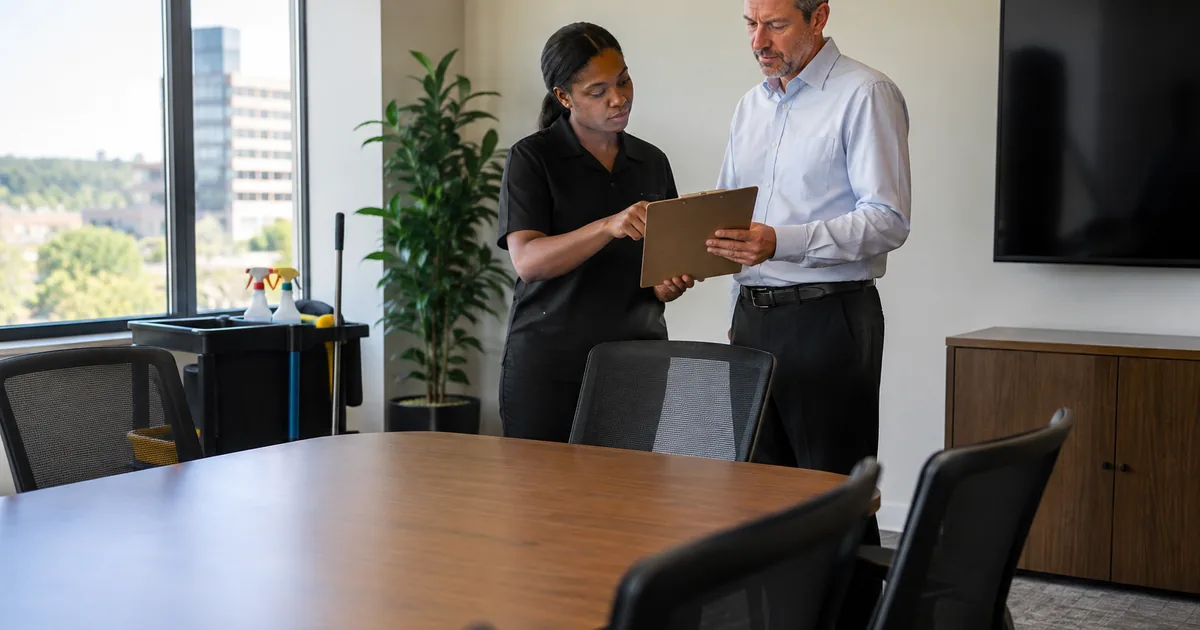
To arrange commercial cleaning in Clayton, send your business name, approximate area, restroom count, preferred service date or window, and onsite contact. Prime Cleaning MO LLC provides commercial pricing after a FREE IN-PERSON walkthrough. That visit establishes what needs cleaning, how the space can be accessed and which tasks belong in the quote.
Before the visit, identify your main concern: restroom upkeep, tracked-in dirt at the entrance, breakroom residue or inconsistent attention to shared surfaces. Then choose someone who can explain both the building and the business’s operating needs to attend.
The goal is a written scope that you can evaluate, not simply a number attached to square footage. Two similarly sized offices can require different work because their layouts, surfaces, use patterns and access restrictions differ.
Gather five details before requesting the visit
Start with your business name and the Clayton service address, including the suite or floor. Provide the approximate area to be cleaned rather than automatically using the entire leased area. If you only know the lease figure, say so and identify excluded rooms during the walkthrough.
Next, count restrooms and describe them briefly. Two single-user restrooms are different from two multi-stall facilities. Include the number of fixtures if you know it, but do not delay your inquiry to produce a perfect inventory.
Finally, provide the requested date or service window and an onsite contact who can admit the walkthrough representative. Explain whether the space is occupied during that window. A practical inquiry might read: “Our business occupies one office suite with two single-user restrooms. We need reception, work areas and the breakroom assessed; our storage room is excluded. Our office manager can provide access.” Add the approximate area and your preferred window before sending.
Explore our commercial & janitorial service and cleaning in Clayton, MO for property-specific information.
Walk the space in the order people use it
Begin at the entrance and follow the route employees and visitors actually take. This reveals tracked-in soil, door-glass fingerprints and transition areas that a room count misses. Continue through reception, work areas, meeting rooms, the breakroom and restrooms.
For each zone, identify its use, surfaces, cleaning concern and access limits. Ask that exclusions be recorded alongside included tasks so a closed office or locked storage room does not become an assumption.
Separate shared areas from individual workstations
Show which desks may be cleaned and what must remain untouched. Decide whether employees must clear surfaces beforehand and whether monitors, keyboards or other electronics are excluded. Cleaning around paperwork is not the same as cleaning an unobstructed desktop.
For conference rooms, distinguish table surfaces and chair arms from equipment such as speakerphones and presentation controls. Identify manufacturer-care requirements before adding delicate equipment to the scope.
Make restroom and breakroom tasks explicit
Point out toilets, urinals, sinks, partitions, mirrors, dispensers and waste containers. Confirm whether dispenser refilling is requested and who supplies compatible consumables. Do not assume that cleaning includes purchasing paper products or soap.
In the breakroom, separate counters and sink cleaning from dishes, refrigerator interiors and microwave interiors. If food must be removed before an interior task, assign that preparation to someone before scheduling.
Match floor and surface care to the materials
Identify carpet, resilient flooring, tile, wood and natural stone during the visit. If a surface’s composition is uncertain, check building records or ask property management rather than choosing a product by appearance. Bring available manufacturer-care instructions to the walkthrough.
Agree on routine floor tasks separately from specialty treatments. Vacuuming carpet does not mean extraction is included; mopping a hard floor does not establish a stripping, refinishing or restoration scope. Point out staining, worn finishes and damaged grout so cleaning expectations do not become repair expectations.
For example, a dull patch on a marble reception counter may be etching rather than removable dirt. Acids can damage marble, so a generic vinegar solution is not an appropriate default. Use manufacturer-safe care and discuss whether a surface problem needs a specialist instead of more aggressive cleaning.
If interior windows are wanted, request them as an add-on and identify the panes, partitions and accessible surfaces involved.
Set workable access, security and scheduling boundaries
Explain when the office is occupied, which rooms require quiet and whether appointments or meetings affect access. Select a preferred service window, then have its feasibility confirmed. Do not build your operating plan around an assumed completion time.
In a multi-tenant Clayton building, check with management about visitor entry, elevator use, loading access and waste disposal. Share applicable instructions before service. Clarify where cleaning equipment can be staged without obstructing corridors, exits or occupied work areas.
Designate who will handle entry and locking up, and agree on a secure method for sharing access instructions. Avoid placing alarm codes or other sensitive information in an openly circulated scope document.
Identify confidential files, restricted offices and equipment that must not be moved. Also clarify whether cleaning around furniture is sufficient or whether an agreed preparation step is necessary. Detailed work may take more than one day; assess that possibility rather than expecting every task to fit a single visit.
Distinguish routine soil from work needing separate assessment
Tell the walkthrough representative if renovation, water damage, unusual residue or a spill prompted the request. Those conditions should not be folded into ordinary office cleaning without assessment. Describing the source of the mess helps determine the appropriate next step.
Flag renovation dust before planning cleanup
If the request is post-construction rather than routine commercial cleaning, explain whether the concern is dust, debris or both. For a residential post-construction inquiry, provide bedroom and bathroom counts as well. Describe affected rooms and whether construction activity is still underway.
Suspected lead, asbestos, silica or biohazards require appropriate specialists and contractor assessment, not routine cleaning. Do not sweep or vacuum suspect material merely to make the space ready for a walkthrough.
Identify industrial hazards without assuming acceptance
For an industrial space, provide the same business, area, restroom, window and contact details, and disclose whether hazardous waste is present. Industrial pricing also follows a FREE IN-PERSON walkthrough. Disclosure supports assessment; it does not mean hazardous work is accepted.
Separate cleaning from any disinfection request
Ask for visible soil removal as a defined task, and discuss disinfection separately where appropriate. CDC guidance calls for cleaning before disinfection. A request to “sanitize everything” is too vague to establish which surfaces, products and procedures are intended.
For example, shared door handles and restroom touchpoints may merit a specific discussion, while a delicate desktop finish needs product-compatibility checks. Identify the surfaces first, then confirm manufacturer-safe care and appropriate product use.
When an EPA-registered disinfectant is used, the surface must remain visibly wet for the full label contact time. There is no universal number of minutes that applies to every product. Never mix cleaners.
Coordinate with staff so they do not add their own chemicals to products already in use. Clear communication about surfaces and products is more useful than an unsupported promise about health outcomes.
Review the proposed scope before approving service
After the walkthrough, compare the quote with your room-by-room notes. Check included areas, tasks, exclusions, any proposed visit frequency, access arrangements and requested add-ons. Ask for clarification wherever a broad phrase such as “office cleaning” hides a decision you discussed.
Use concrete comparisons. If one proposal includes breakroom appliance interiors and another covers only exterior surfaces, they describe different work. If restroom supplies are your responsibility, account for that internally rather than assuming they arrive with the cleaning equipment.
Choose one contact to communicate changes, flag unavailable rooms and report concerns with a location and task description. “The sink surround in the rear restroom needs attention” is easier to act on than “the office was missed.”
To request commercial service from Prime Cleaning MO LLC in the St. Louis metro, prepare the five inquiry details and arrange the free in-person walkthrough before pricing. By Prime Cleaning MO Team.