Commercial & Janitorial
Janitorial vs. Commercial Cleaning: What's the Difference?
Janitorial and commercial cleaning are related terms, not fixed packages with identical definitions across providers. Learn how to turn those labels into a practical scope for your workplace.
Understand the overlap before comparing the labels
Janitorial versus commercial cleaning is not always a choice between two completely separate services. Commercial cleaning is commonly used as an umbrella term for cleaning business premises, while janitorial often describes the ongoing tasks that keep those premises usable between more detailed visits. Providers may use the words differently. A service listed as commercial can include regular janitorial tasks, and a janitorial proposal may include occasional detail work. The label is a starting point for a conversation, not a reliable substitute for the actual list of rooms, surfaces, and responsibilities.
For a St. Louis business, the practical question is what your workplace needs and how that work will be scheduled. Start with the areas used by employees and visitors, the condition you want maintained, and any tasks outside ordinary premises care. Prime Cleaning MO LLC provides commercial pricing after a free in-person walkthrough. Use the Commercial Cleaning page to frame the request, then explain the building rather than relying on a single service term. A clear scope makes it possible to compare proposals even when different companies describe similar work with different names.
Janitorial usually emphasizes ongoing upkeep
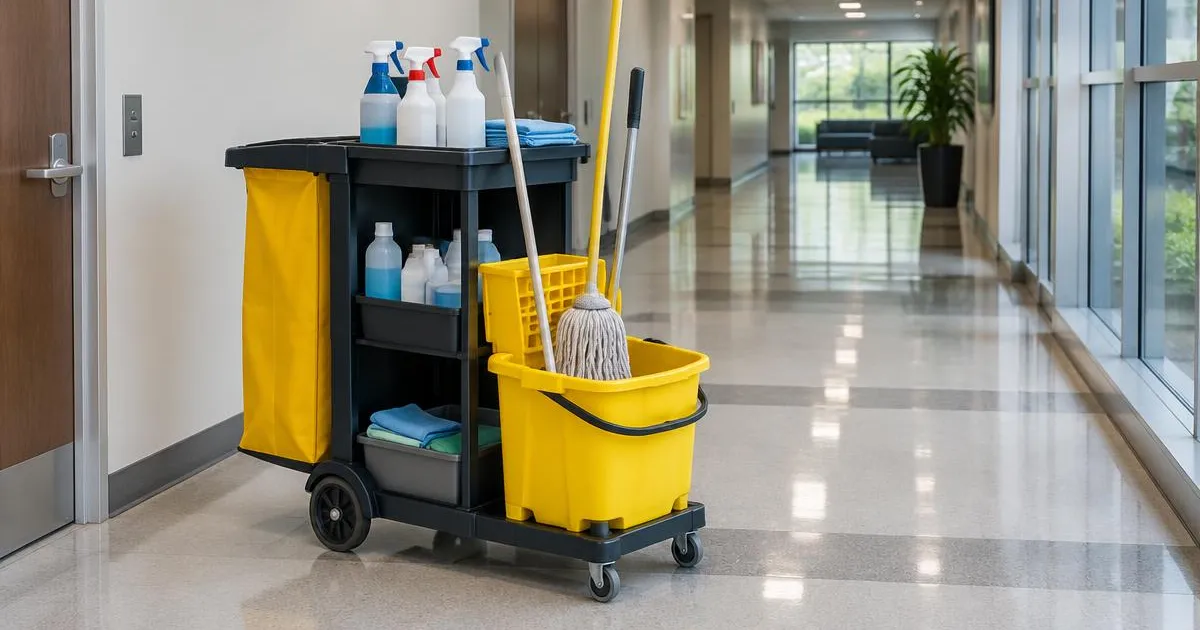
Janitorial work commonly refers to repeated tasks such as emptying designated waste containers, cleaning restroom surfaces, maintaining accessible floors, and wiping agreed shared surfaces. The exact work and schedule vary by facility. An office with daily visitors may need a different pattern from a small suite used intermittently by a hybrid team. Calling the work janitorial does not automatically mean daily attendance, daytime staffing, or responsibility for every task that arises in the building. Those details need to be confirmed rather than inferred from the service name.
Think of janitorial as a pattern of maintenance that supports the way the facility operates. The scope should say which areas are included, what counts as a cleared surface, who supplies consumables, and how exceptions are reported. It should also explain limits, such as restricted rooms, confidential desks, or items that remain untouched. If staff expect cleaners to wash personal dishes, organize workstations, or purchase restroom supplies, discuss those expectations directly. A recurring visit does not automatically transfer every housekeeping or facilities responsibility from employees and management to the cleaning provider.
Explore our commercial & janitorial service and cleaning in St. Louis, MO for property-specific information.
Commercial cleaning describes a wider business context
Commercial cleaning generally identifies the type of customer or property rather than one fixed level of detail. Offices, customer-facing spaces, and other business premises can all need commercial cleaning, but their appropriate tasks are not interchangeable. A reception area, a staff breakroom, and a room with specialized equipment present different access and care questions. The broad term can encompass routine upkeep as well as specifically agreed deeper work. It does not, by itself, establish whether a provider handles a particular industry, material, piece of equipment, or specialist cleaning process.
When discussing commercial cleaning, describe the actual activities in the space and any restrictions that affect service. Explain whether employees work during the proposed visit, whether customers have access, and whether a landlord maintains some shared areas. Identify surfaces with special care requirements and any work that must be coordinated with internal staff. These details are more informative than choosing the broadest label available. They help establish the boundary between general premises cleaning and tasks that need separate expertise, separate authorization, or a different provider altogether.
Separate maintenance from the initial reset
One important distinction is not janitorial versus commercial but starting condition versus ongoing upkeep. A facility may need accumulated dust and neglected detail areas addressed before a maintenance plan can reasonably preserve the desired condition. That initial reset should be described explicitly rather than buried inside a promise of routine service. Tell the provider about the last substantial cleaning, known problem areas, and rooms that have been difficult to access. If you do not know the maintenance history, say so and allow the current condition to guide the assessment.
Confirm the starting condition
At Prime Cleaning MO LLC, standard and recurring service begin only after an initial deep clean. Review the initial work and later maintenance together so you understand how they relate. A proposal for the first clean should not be compared as though it were identical to an established upkeep visit. The Deep Cleaning page can help explain the difference between a reset and maintenance in general, but commercial scope still needs its own facility review. Commercial pricing is provided after a free in-person walkthrough, where the actual site and requested work can be assessed.
Frequency and detail are separate decisions
Frequent service is not automatically more detailed service, and a one-time appointment is not automatically a deep clean. Frequency answers how often agreed work occurs; scope answers what happens during each visit. A restroom may require regular attention while some detail surfaces are addressed on a different schedule. Write those decisions separately so a periodic task is not mistaken for a requirement at every visit. This distinction helps a business avoid expecting a maintenance appointment to include every possible task simply because the service is described as commercial.
Likewise, a task performed regularly still needs a clear boundary. Floor care should identify suitable routine methods for the material and distinguish them from specialist restoration. Desk cleaning should identify accessible surfaces rather than imply document handling. Interior window cleaning is an optional commercial add-on and should be listed separately with the intended windows and access details. When frequency, scope, and optional work are recorded independently, it is easier to understand what a provider is offering and revise one part of the plan without creating confusion about the rest.
Clarify supplies, access, and staff responsibilities
Some of the most consequential differences between proposals are operational rather than linguistic. Ask who provides equipment, cleaning supplies, waste liners, and restroom consumables. If restocking is included, clarify whether it uses stock already on site or another agreed arrangement. Identify who orders replacement supplies and who receives notices when stock is low. A phrase such as full janitorial service is not precise enough to settle these responsibilities. The same applies to waste and recycling: confirm designated streams, collection points, and building rules rather than assuming every container follows the same process.
Access arrangements also belong in the scope discussion. Agree on arrival windows, authorized contacts, restricted areas, and procedures for locking up. Share alarm and key information through the approved private channel, not an openly posted checklist. If employees will be working late, explain how occupied rooms should be handled. Set expectations for clearing desks, removing confidential documents, and putting away personal belongings before service. These practical boundaries make both janitorial and broader commercial work easier to deliver because the cleaning team is not forced to make security or document-handling decisions on the business’s behalf.
Identify specialist work rather than assuming inclusion
Neither janitorial nor commercial cleaning automatically means a provider handles hazardous substances, clinical instrument processing, industrial equipment, or technical remediation. If your facility has unusual materials, regulated processes, or restricted operational areas, disclose them before the service is assessed. General premises cleaning should not be stretched into a specialist task merely because it occurs inside a commercial property. The responsible approach is to identify the requirement, confirm whether it is within the provider’s capabilities and agreed scope, and arrange an appropriate alternative if it is not.
Be equally precise about outcome claims. Cleaning and disinfecting describe different processes, and neither should be used as shorthand for a guaranteed disease-prevention result. Where disinfection is part of the agreed work, appropriate products and label directions matter, including the required contact time. Existing damage, worn finishes, and persistent discoloration may also remain after cleaning. Note these conditions during the walkthrough so expectations distinguish removing soil from repairing or restoring a surface. A trustworthy scope is specific about what will be attempted and does not promise that every visual problem is a cleaning problem.
Choose a plan by comparing tasks, not terminology
Create a simple comparison based on areas, tasks, frequency, starting condition, optional work, and access responsibilities. Ask each provider to clarify any broad phrase that could mean more than one thing. Check whether the plan includes an initial reset, which surfaces must be cleared, and how incomplete tasks or newly discovered conditions will be reported. If two providers use different service names but describe equivalent work, the names are not a meaningful obstacle to comparison. If they use the same name but describe different work, the written scope should guide your decision.
To discuss a workplace plan with Prime Cleaning MO LLC, use the Quote page or call (314) 274-6907. Prepare the business address, approximate square footage, restroom count, occupancy pattern, and preferred access window. Mention requested interior windows or other additions explicitly. Commercial pricing follows a free in-person walkthrough, and standard or recurring service follows an initial deep clean. Whether you call the result janitorial service or commercial cleaning, the useful outcome is the same: a clearly documented plan that matches your premises, assigns responsibilities, and can be reviewed when the way your business uses the space changes.