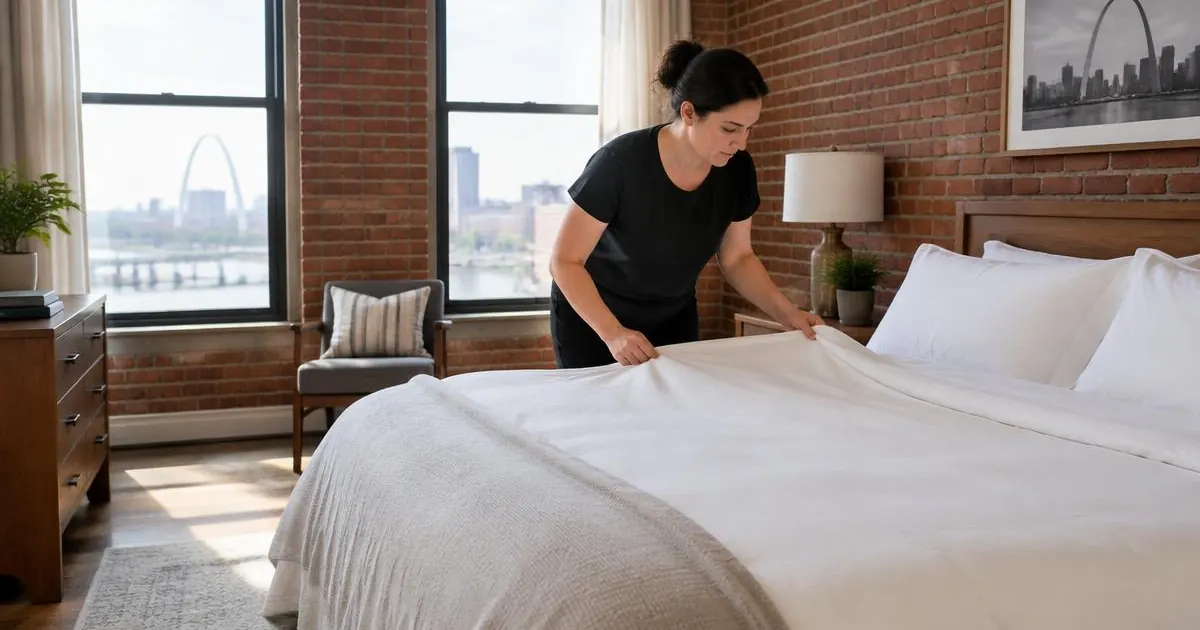
Airbnb/Vacation Rental
Vacation Rental Cleaning Mehlville: Late Checkouts and Entry Permission
A practical turnover plan for Mehlville hosts when guests leave late, rooms remain occupied or entry permission is unclear.
vacation rental cleaning Mehlville: Late Checkouts and Entry Permission
When checkout slips or a guest remains inside, vacation rental cleaning Mehlville hosts arrange becomes an access decision before it becomes a cleaning task. A working door code does not establish permission to enter, and a scheduled appointment does not prove the property is vacant. This guide from the Prime Cleaning MO Team explains how to prepare a handoff that protects guest privacy while giving Prime Cleaning MO LLC clear instructions about what can proceed.
Start by separating three facts: the scheduled checkout, the last confirmed occupancy status, and the host’s authorization for lawful entry. Write each down rather than treating them as interchangeable. If someone is still sleeping, packing, showering, or waiting for transportation, describe that situation accurately. The goal is not to push cleaning into an uncertain window; it is to establish an authorized scope that fits the property’s actual condition and availability.
Give intake the details that change an occupied turnover
For the initial request, provide the number of bedrooms, bathrooms, approximate square footage, approximate bookings over a stated period, and whether laundry is needed. Add the next expected arrival and any known late-checkout request. These details help distinguish a small vacant turnover from a larger property where occupancy and laundry could restrict the available work.
Then answer the questions that matter specifically when departure is uncertain. Is this an entire-home rental or a property with separately occupied rooms? Who can verify that guests have left? Are any rooms locked, reserved for the owner, or excluded? Are pets still present? Identify the person authorized to decide whether work may proceed, along with a backup contact.
Tell Prime Cleaning MO LLC whether the booking covers only turnover tasks or includes separately requested work. Discuss scheduling and access contingencies before confirming the appointment; do not assume waiting, returning, or extending the visit can automatically be accommodated.
Explore our airbnb/vacation rental service and cleaning in Mehlville, MO for property-specific information.
Confirm lawful entry before using keys or codes
The host must confirm lawful access under the applicable booking terms, guest permissions, and legal requirements. Cleaning staff should not be asked to settle an occupancy dispute or interpret an expired checkout time as authority to enter.
Send an explicit entry authorization
Use a clear message such as: “Departure is confirmed, I authorize lawful entry, and these rooms are available for cleaning.” Include the approved entry method and any restricted areas. Share access credentials through the agreed communication channel rather than placing them in a broadly visible document.
Treat conflicting information as a stop point
If the host reports vacancy but a guest answers the door, the situation has changed. Pause entry and contact the designated decision-maker. Likewise, luggage, an occupied bedroom, or a guest requesting more time calls for clarification—not a presumption that cleaning can continue. Confirm who will communicate with the guest; that responsibility should remain with the host or authorized property manager.
Choose a workable response to late checkout
A late departure changes the plan, but it does not justify rushing past access checks. Ask the host to establish the revised departure expectation, verify permission, and discuss whether the appointment can still proceed. Any adjusted schedule depends on actual availability and the remaining scope; same-day completion should not be assumed.
For example, if guests are packing throughout a two-bedroom home, postponing entry may be more practical than attempting to work around them. If a separately rented bedroom remains occupied while authorized common areas are vacant, limited cleaning might be considered only after the host confirms permission, boundaries, and guest coordination. It must not be presented as a completed whole-property turnover.
Set a decision point for the host to provide an update. Discuss what happens if no reliable departure confirmation arrives: revise the appointment, reassess scope, or stop the handoff process. The host should manage any resulting communication with incoming guests.
Define boundaries for belongings and shared spaces
An occupied rental is not simply a vacant rental with extra clutter. Personal items create privacy and handling questions, while guests moving between rooms can undo cleaning or interrupt safe product use. Establish boundaries before approving any limited work.
Do not treat belongings as abandoned
A suitcase beside the door, groceries in the refrigerator, or clothing on a bed may still belong to a current guest. Do not move, pack, discard, or otherwise handle guest belongings without permission. Ask the host to obtain appropriate authorization and provide specific instructions. If permission is missing, leave the affected area untouched and discuss how that limits the scope.
Keep authorized work genuinely separate
Ask whether access routes, bathrooms, and supplies can be used without entering occupied areas. If cleaning would repeatedly cross a guest’s private space, a partial visit may not be workable. Discuss whether a limited status report is needed and how excluded rooms will be recorded, rather than allowing “cleaning started” to be mistaken for “ready for arrival.”
Recalculate laundry and supplies after the actual departure
Laundry planning should start with the intake answer, then be confirmed against the actual turnover. Discuss whether washing, drying, folding, or bed-making is requested, where laundry would happen, and whether machines are available. A guest using the washer or leaving wet bedding changes capacity; it should trigger a conversation rather than an assumption that every linen task will fit.
Base spare-linen planning on the beds, towel use, booking pattern, and actual washing and drying capacity. There is no universal spare quantity that suits every property. For example, a host with several beds and a small dryer may need a different inventory approach from a host using an approved off-site laundry arrangement. Confirm responsibility for providing replacements.
Restocking also requires agreement. Identify the products, storage location, quantities to place, and who purchases supplies. Discuss whether linen counts or shortage reports are wanted and feasible. Missing stock, unavailable laundry access, or occupied beds should be communicated as unresolved items, not silently treated as completed tasks.
Protect cleaning quality without expanding the scope silently
Once vacancy and access are confirmed, agree on the turnover tasks for the available rooms, such as cleaning bathrooms, kitchen surfaces, floors, and bed preparation when arranged. Use manufacturer-safe surface care, never mix cleaners, and avoid acids on stone. Disinfection should be used only when appropriate and with the full label contact time; a shortened access window is not a reason to bypass product directions.
A periodic deep clean addresses accumulated buildup or detailed work beyond the agreed turnover. It is separate planning, not an automatic prerequisite for Airbnb cleaning. Appliance interiors and inside cabinets are optional deep-clean add-ons, not assumed turnover tasks. Interior window cleaning is not offered as an Airbnb turnover add-on.
If departure reveals conditions outside ordinary cleaning, pause and discuss scope. Do not assume treatment for pests, mold, biohazards, or bodily fluids is available. Extra detailing may require a separate appointment, and work beyond deep cleaning can take more than one day.
Close with a factual handoff, not an assumed release
Before work begins, discuss the desired handoff details: who receives the update, how access is secured afterward, and who decides the property is ready for the next guest. Confirm whether written reports or damage photos are requested and what they should cover. Photographs should avoid unnecessary exposure of personal information or guest belongings and follow the agreed permission boundaries.
A useful completion message distinguishes completed tasks, excluded areas, and unresolved issues. For example: “Authorized vacant areas cleaned; occupied bedroom excluded; laundry not completed because machine access was unavailable.” That is more actionable than an unexplained “done.” Damage documentation, if agreed, should describe observations without guessing who caused them.
If a return visit is needed, discuss availability and scope separately. Keep entry credentials, locking instructions, and the next authorized contact current. The host’s final readiness decision should reflect the actual handoff, including any cleaning or supply tasks that still need attention.