Commercial & Janitorial
Office Janitorial Cleaning Ballwin: Meeting-Room Resets Around Events
Build an office cleaning plan that follows room use, meeting schedules, and shared furniture rather than relying on a single building-wide frequency.
office janitorial cleaning Ballwin: Meeting-Room Resets Around Events
A useful office janitorial cleaning Ballwin plan starts with how people use each room, not just its floor area. For Prime Cleaning MO LLC, the planning conversation should identify which spaces host visitors, where food appears, and which furniture moves between meetings. A conference room used for occasional interviews needs a different approach from one that hosts catered training and back-to-back presentations.
Create a room list covering reception, workstations, meeting rooms, restrooms, break areas, storage, and circulation routes. Beside each space, record normal occupancy, food use, access restrictions, and the person who can authorize changes. Mark rooms with confidential documents or equipment that cleaners should not move.
Then ask a practical scope question: what must be ready when the next occupant arrives? Clear tables, usable seating, and an unobstructed floor may be priorities between meetings, while detailed edge cleaning belongs in a separate service window. Defining that difference prevents a quick reset from being mistaken for a deeper cleaning visit.
Build meeting-room resets around the event calendar
Meeting-room cleaning works best when it follows the event calendar. Identify the setup period, the actual event, and the point when attendees and belongings are gone. Confirm whether the office expects cleaning staff to return during business hours or complete work after the final meeting.
Before the room is occupied
Agree on the required seating arrangement and who moves tables. Check that the tabletop is clear, chairs are usable, bins have capacity, and the floor is ready for visitors. Presentation equipment, cables, and personal devices should remain untouched unless handling is expressly authorized. Ask whether refreshments arrive before or after cleaning so that setup does not undo completed work.
After attendees leave
Distinguish a reset from event cleanup. A reset might cover agreed table surfaces, visible crumbs, waste, and chair alignment. A catered workshop may also require attention to food spills, chair seats, and nearby flooring. If another meeting starts immediately, assign an office contact to manage essential interim tasks rather than assuming an unscheduled cleaning visit is available.
Explore our commercial & janitorial service and cleaning in Ballwin, MO for property-specific information.
Give shared furniture its own cleaning rules
Shared furniture creates cleaning questions that a room-based list can miss. Chairs move from conference rooms to private offices; folding tables may return to storage with sticky edges. Identify furniture that circulates and decide whether it should be checked before storage, before reuse, or during a scheduled visit.
Record materials where known, including upholstered seats, coated wood, laminate, leather, and adjustable chair components. Use manufacturer-safe methods suited to each surface. Avoid acids on stone, never mix cleaners, and do not assume a product suitable for a tabletop is suitable for upholstery or electronics.
For a practical decision example, consider a shared chair with crumbs on its seat versus one with an unexplained stain. The first may fit agreed routine care; the second needs assessment before treatment. Cleaning should not be presented as restoration. Confirm who approves moving furniture, whether chairs can be turned or repositioned safely, and which areas must remain accessible throughout the visit.
Assign frequencies by traffic, food, and touchpoints
Avoid assigning the same frequency to every room simply because it is convenient to schedule. Start with use patterns, then adjust after observing conditions. Restrooms and food areas need attention based on occupancy and actual use, while an infrequently occupied meeting room may need a pre-use check rather than identical treatment every visit.
Separate visit tasks from periodic detail
For each room, define what happens on each scheduled visit and what belongs on a periodic detail list. Visit tasks might include agreed waste removal, accessible surface cleaning, and floor care. Periodic work could address reachable vents, chair bases, or furniture edges when access and materials permit. These are planning examples, not a universal checklist.
Use events as triggers for changes
A lunch presentation may trigger additional cleaning even if the room was serviced recently. Conversely, a canceled event may remove the need for an extra reset. Ask who reports changes, how service adjustments are authorized, and whether the requested work fits the available access window before confirming it.
Coordinate break areas, restrooms, and routes between rooms
Meeting-room readiness depends partly on adjacent spaces. Guests may arrive through reception, collect drinks in a break area, and use nearby restrooms. Review that route during planning so a polished conference table does not distract from an overflowing bin or a spill along the path.
Define responsibility for mugs, leftover catering, refrigerator contents, and personal food containers. Cleaning staff should not have to guess whether an item is waste or something an employee intends to keep. Ask who supplies restroom consumables, who monitors them between visits, and whether replenishment is included in the agreed scope.
Set appropriate boundaries for sanitation. Disinfect only where appropriate, using a compatible product and the full label contact time. A quick wipe should not be described as disinfection when those conditions are unmet. Report leaks, persistent moisture, or suspicious material to the designated contact; do not assume routine janitorial service includes mold removal or hazardous waste handling. Keep work areas and drying floors controlled according to site procedures.
Prepare for the required in-person commercial walkthrough
Prime Cleaning MO LLC requires a free in-person walkthrough before pricing commercial or industrial cleaning, including commercial post-construction work. An address and square footage alone cannot show furniture density, room access, surface conditions, or the reset demands created by events.
When requesting the walkthrough, provide the business name, approximate square footage, restroom count, preferred date and time window, and onsite contact. For a Ballwin office, also explain entry procedures, parking or loading restrictions, alarm requirements, and any rooms unavailable during the proposed visit. Do not send security codes through an unsuitable communication channel.
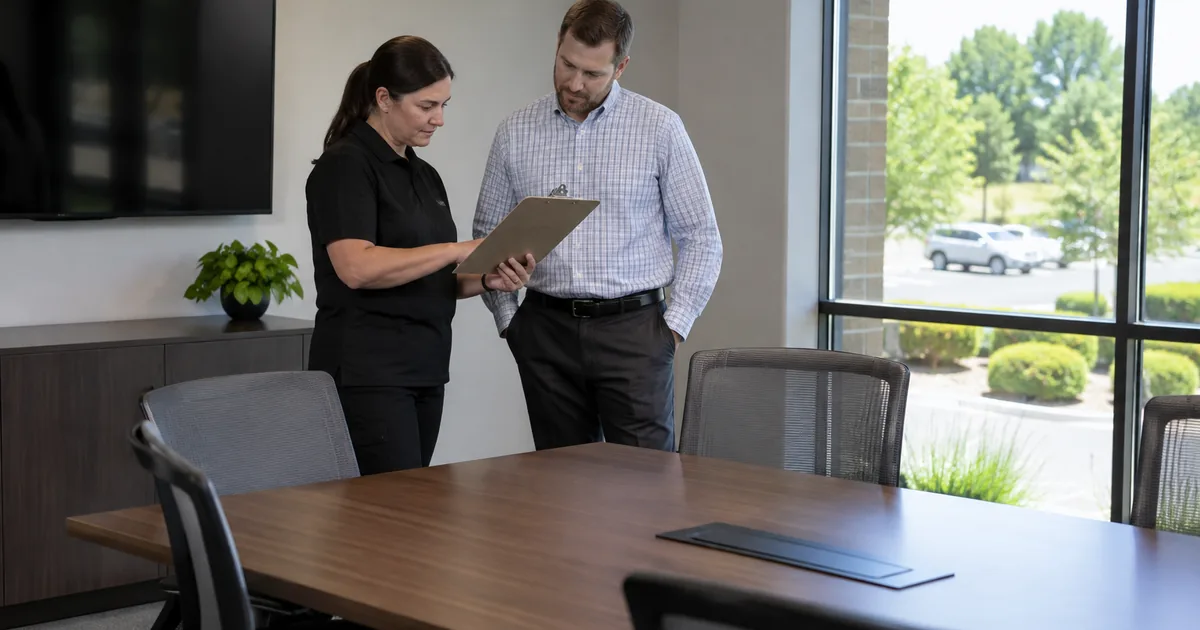
Have the onsite contact show a typical meeting setup and explain the busiest event scenario. Point out shared furniture, food service locations, sensitive equipment, and spaces that require approval before entry. Ask which tasks are included, which need separate authorization, and what cannot safely be undertaken. Hazardous work should never be assumed or promised. The resulting scope should reflect observed conditions rather than a generic room count.
Separate janitorial work from deep cleaning and other services
A useful scope names exclusions as clearly as included tasks. Office janitorial planning should specify whether appliance interiors, cabinet interiors, interior glass, or additional detailing are requested rather than treating them as automatic. Interior windows are optional for all services except Airbnb turnovers; that exception should not be used to define an office package.
If discussing Prime Cleaning MO LLC's other service categories, keep their boundaries distinct. Deep-clean appliance interiors and inside cabinets are optional add-ons. Move-In/Move-Out cleaning includes inside and outside cabinets and appliances. Standard/recurring service is available only after an initial deep clean, not as a one-time or first-time standard cleaning; the first standard/recurring quote includes that deep clean.
Do not substitute those service names for a written commercial scope. Ask whether a request concerns ongoing office upkeep, an occupancy change, post-construction conditions, or detailing beyond a deep clean. More extensive detailing may take more than one day. Confirm access and scope before making scheduling assumptions.
Review results and adjust the plan with one contact
Choose one office contact to maintain the room list, event calendar, and approved scope. That person should communicate schedule changes and distinguish a missed agreed task from newly requested work. A note such as “table edges remained sticky after catering” is more actionable than “the meeting room needs more attention.”
Review the plan when occupancy changes, furniture is replaced, or events become more frequent. If chairs repeatedly return to storage dirty, add a defined inspection or cleaning step at that handoff. If a room is consistently inaccessible, change the access arrangement rather than leaving an impossible task on the schedule.
Keep a simple record of concerns, decisions, and approved scope changes without photographing confidential information. The aim is a workable agreement: rooms ready for their intended use, surfaces treated appropriately, and responsibilities understood. A thoughtful walkthrough and clear communication provide a stronger basis for Ballwin office janitorial planning than an oversized checklist.