Commercial & Janitorial
Office Janitorial Cleaning Mehlville: Cleaning Around Occupied Workspaces
A useful office cleaning plan connects each room’s needs with access rules, employee activity, and clear service boundaries—not just a nightly task list.
office janitorial cleaning Mehlville: Cleaning Around Occupied Workspaces
Planning office janitorial cleaning Mehlville starts with understanding how people use the building, not simply counting rooms. A reception area may stay occupied while private offices empty out; a meeting room may be available only between appointments. Prime Cleaning MO LLC needs those differences identified so the proposed scope can address cleaning needs without treating employees, visitors, or confidential work as obstacles.
Build a room list and record who uses each space, when it becomes available, and whether cleaning requires permission. Ask employees which activities are most disruptive: vacuum noise during calls, moving chairs during focused work, or temporary restroom closures. Use those answers to define workable access windows rather than assuming that everyone leaves at the same time.
Choose one office coordinator to resolve questions. That person should be able to approve access changes, identify restricted rooms, and explain what happens when a scheduled meeting runs late. A clear decision path helps prevent cleaners from interrupting several employees for the same answer.
Prepare for the Required In-Person Walkthrough
Commercial and industrial cleaning require a free in-person walkthrough before pricing from Prime Cleaning MO LLC. Commercial post-construction work has the same requirement. A phone description or photographs can help prepare the discussion, but they do not replace seeing the space, its condition, and its access constraints.
When requesting the walkthrough, provide the business name, approximate square footage, restroom count, preferred date and time window, and an onsite contact. Also mention whether the office will be occupied during service, whether multiple tenants share facilities, and whether cleaning staff must check in with building management.
During the visit, show the contact representative both public areas and less obvious spaces: storage rooms, secondary restrooms, staff entrances, and shared corridors. Identify which areas your business controls. For example, a tenant may want its suite cleaned but have no authority to approve work in the building lobby. Resolve that boundary before it becomes part of a pricing discussion.
Explore our commercial & janitorial service and cleaning in Mehlville, MO for property-specific information.
Set Frequencies by Room Use and Actual Conditions
A useful frequency plan separates rooms by traffic, soil, and operational importance. Start with observed conditions, then adjust the proposed schedule after reviewing how the office functions. Avoid assigning every task the same frequency merely because the rooms share an address.
Reception, workstations, and meeting rooms
Reception floors may need attention more often than a seldom-used private office. Meeting rooms need scheduling tied to bookings, especially when refreshments are served. At workstations, distinguish accessible surfaces from desks covered with papers or equipment. Ask whether employees will clear a designated area or whether cleaning should stop at exposed edges. A room used occasionally may need an inspection each visit without receiving every task each time.
Restrooms and shared food areas
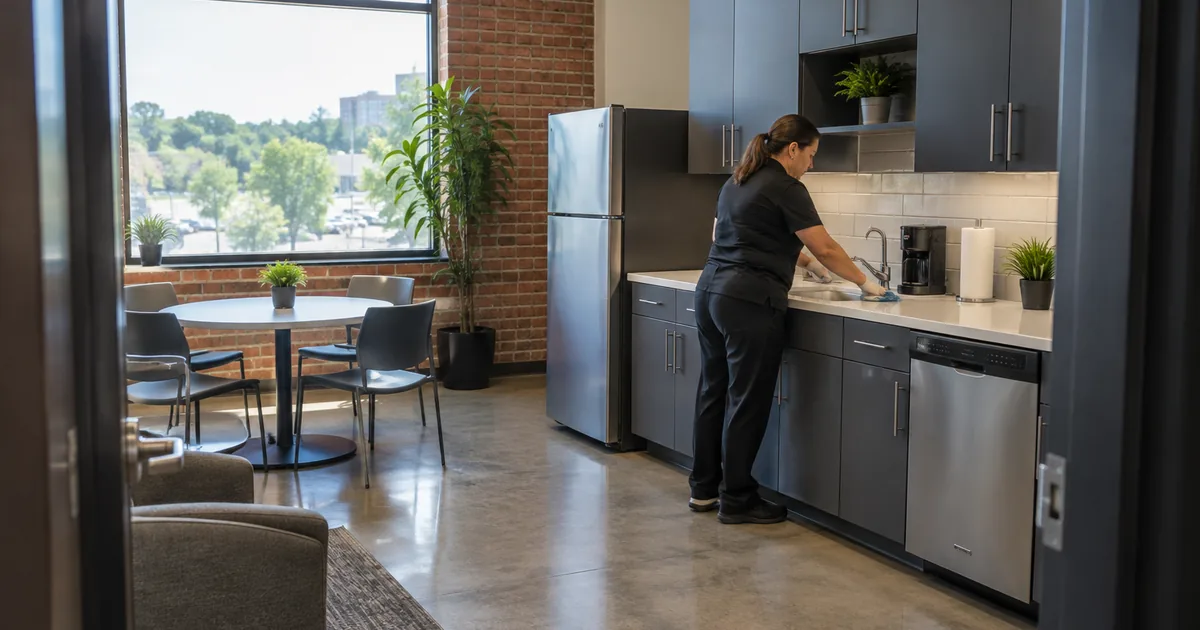
Restroom needs depend on users, visitor access, and conditions between visits. Discuss fixtures, floors, waste, dispensers, and who supplies consumables. In a shared kitchenette, separate routine surface cleaning from accumulated residue or interior appliance work. If spills develop during the workday, identify the employee response process; a scheduled service visit does not replace immediate attention to a slipping hazard.
Sequence Work Around Employees and Visitors
Agree on a sequence that keeps necessary spaces usable. One option is to clean vacant meeting rooms first, move into available private offices, and address noisy floor work when calls or appointments are least likely. The right order depends on the office’s actual schedule, not a universal route.
For an occupied suite, ask whether staff can temporarily use another restroom while one is being cleaned. Discuss how wet-floor areas will be marked and how employees will reach exits without crossing the active work zone. Cleaning equipment should not block doorways, accessible routes, or emergency equipment.
Create a fallback for unavailable rooms. If a conference call continues past the planned access window, should the cleaner return later within the agreed visit, skip the room, or contact the coordinator? Document that choice. Also identify rooms where an interruption is unacceptable, such as an office conducting confidential interviews, so knocking does not become the default access method.
Define Entry, Security, and Desk Boundaries
Occupied-office access needs rules even when someone is present to open the door. Identify the authorized entrance, check-in procedure, permitted rooms, and any escort requirement. If after-hours access is being considered, discuss key or credential handling, alarm responsibilities, and the process for reporting a door that cannot be secured.
Set a clear policy for papers, personal items, and electronics. Cleaning staff should not have to decide whether a document is disposable or whether an unplugged device is safe to move. Designate accessible surfaces and approved waste containers; exclude unidentified materials until the office coordinator gives direction.
Ask who can authorize changes during a visit. An employee requesting extra work may not control the service agreement or access permissions. A simple rule—send scope changes through the designated contact—helps protect both the office and the cleaning plan. Include a procedure for reporting damage, an unexpected spill, or a room that was inaccessible without sharing confidential contents.
Match Surface Care to Materials and Conditions
List sensitive materials during the walkthrough, including stone counters, coated floors, finished wood, screens, and specialty fixtures. Use manufacturer-safe surface care rather than assuming that one product suits every room. Avoid acids on stone, and never mix cleaners. If a surface or finish is unknown, identify it before selecting a treatment.
Disinfection should be used only when appropriate to the agreed scope and conditions. It is not a substitute for removing soil. When a disinfectant is used, follow its label, including the full required contact time and surface compatibility instructions. Access planning must allow that process rather than having employees immediately wipe the surface dry.
Discuss unusual residues or conditions separately. Office janitorial service should not be presented as restoration, mold removal, or hazardous waste handling. If an unidentified substance, suspected hazardous material, or unsafe condition is found, stop work in that area and notify the office contact. Do not build a plan around an assumption that every condition can be safely cleaned.
Separate Routine Scope From Deeper and Optional Work
Write the proposal so included tasks, exclusions, and optional services are distinguishable. For Prime Cleaning MO LLC, standard/recurring service is available only after an initial deep clean; it is not a one-time or first-time standard cleaning. The first standard/recurring quote includes that initial deep clean. Confirm how the proposed office agreement describes its initial work and ongoing visits.
Appliance interiors and inside cabinets are optional add-ons to a deep clean, not automatic inclusions. Move-In/Move-Out cleaning includes inside and outside cabinets and appliances. Interior windows are optional for all services except Airbnb turnovers. For an office request, identify the specific glass, cabinets, or appliances involved instead of relying on a broad phrase such as ‘clean the kitchen.’
Detailing beyond a deep clean may take more than one day. Discuss access implications before approval, especially if additional work would affect occupied rooms. Commercial post-construction cleaning requires its own free in-person walkthrough before pricing; it should not be folded into routine janitorial work without evaluating conditions and boundaries.
Approve a Practical Plan and Review Exceptions
Before service begins, review a written room-by-room scope with the office coordinator. Pair each included task with its frequency, access window, and any prerequisite, such as cleared desks or an unlocked storage room. This is an agreed plan for your office, not a claim that every possible cleaning task is covered.
Use concrete acceptance points: accessible counters addressed, agreed waste containers emptied, and specified floors cleaned with appropriate methods. Keep exceptions separate from completed work. A locked room or desk covered in documents should be reported as an access limitation rather than silently treated as finished.
Revisit the plan when occupancy changes, a department moves, or meeting-room use increases. Ask whether employees experienced avoidable interruptions and whether frequently used spaces need a different schedule. Adjust room priorities and access arrangements first, then discuss any scope or pricing changes. This keeps the cleaning plan connected to the way the Mehlville office actually operates.