Commercial & Janitorial
Office Janitorial Cleaning O’Fallon: Keys, Alarms and Authorized Access
Build an office cleaning plan around room use, surface care and controlled access, then confirm priorities during a free in-person walkthrough.
office janitorial cleaning O’Fallon: Keys, Alarms and Authorized Access
A useful office janitorial cleaning O’Fallon plan starts with how your workplace operates, not a generic list of tasks. Prime Cleaning MO LLC needs to understand which rooms people use, what must remain undisturbed and who can authorize access. Separate routine soil removal from requests that require extra detailing, specialized assessment or a different service scope.
Walk through your office as an employee would: entrance, workstation, meeting room, break room and restroom. Note visible soil, shared touchpoints, flooring and restricted areas. Ask whether staff eat at desks, visitors use employee restrooms or deliveries leave debris near entrances. These answers help distinguish frequently used spaces from rooms that can receive less frequent attention.
Name a primary decision-maker and a backup before discussing scheduling. They should be able to approve room access, resolve scope questions and receive service updates. Keep their business contact details in the service record, while reserving sensitive entry instructions for a separately agreed, controlled communication method.
Prepare for the required in-person walkthrough
Commercial and industrial cleaning, including commercial post-construction work, requires a free in-person walkthrough before pricing. Photographs and floor plans can support the conversation, but they do not replace seeing the premises. Supply the business name, approximate square footage, restroom count, preferred date and time window, and an onsite contact when requesting the walkthrough.
Have the onsite contact show the areas under consideration and identify exclusions. Explain occupancy patterns, floor materials, storage constraints and whether cleaning must happen around employees or after closing. Point out surfaces with manufacturer instructions, existing damage and equipment that should not be touched. Do not include passwords or alarm codes in a general quote request.
Use the visit to resolve boundaries: Are employee dishes included? Who removes confidential waste? Does the office share a lobby with other tenants? Is interior glass part of the request? Pricing should follow the agreed scope rather than assumptions about what an office cleaning package must contain.
Explore our commercial & janitorial service and cleaning in O'Fallon, MO for property-specific information.
Group rooms by use, then assign frequencies
Frequency should reflect use and observed conditions. A small office with occasional visitors has different needs from a busy workplace with frequent meetings. Start with a proposed pattern, then review whether soil returns before the next visit or lightly used rooms receive unnecessary attention.
Entrances, workstations and meeting rooms
Consider entrances and shared meeting rooms first when setting priorities. Track incoming dirt, fingerprints and food residue. For desks, define a clear-surface rule: cleaners work only on accessible, approved surfaces without moving paperwork or personal items. Ask whether chair arms, shared tables and accessible floor edges belong in routine service or periodic detailing.
Restrooms and break rooms
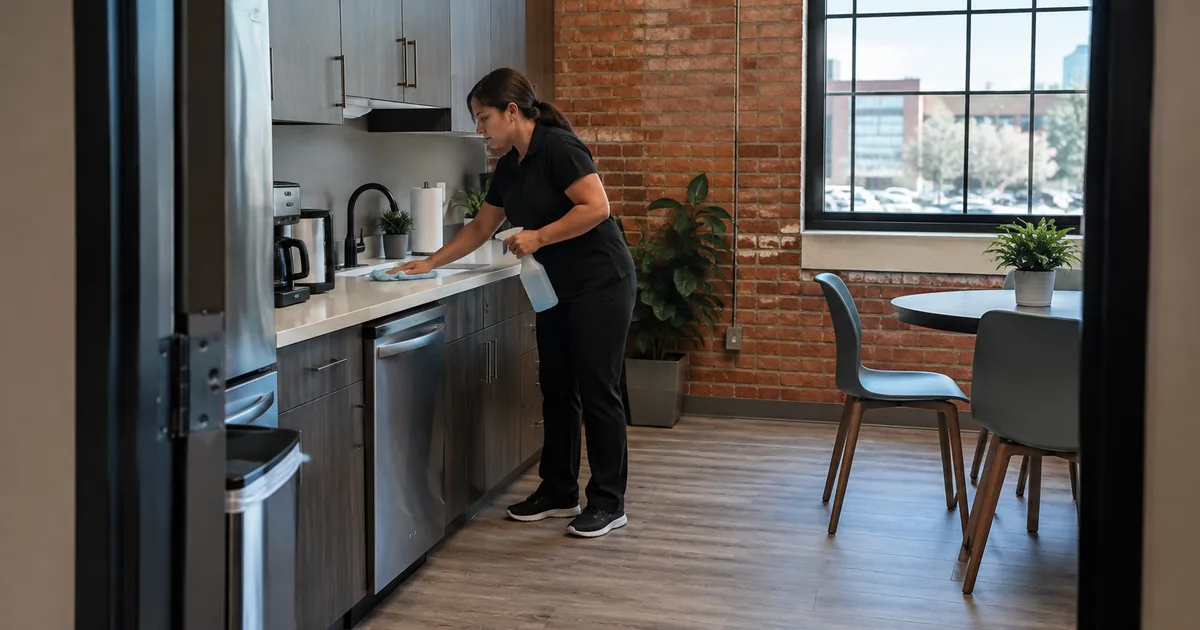
Restrooms and food areas often need closer attention because conditions can change throughout the workday. Agree who checks supplies between visits and who purchases replacements. If a break room becomes messy after lunch, an employee reset may still be necessary between scheduled cleanings. Specify counters, sinks, appliance exteriors and waste removal instead of assuming every interior compartment is included.
Control keys, alarms and authorized contacts
Access planning should answer who grants entry, how authorization is verified and what happens when entry fails. It should not expose actual security information in a room checklist, shared calendar or public-facing document. Keep service scope and sensitive access instructions separate, and limit access details to people who need them.
Use a controlled handoff and escalation process
Ask your security administrator whether individually assigned, limited-access credentials are available. If physical keys are necessary, agree on custody, return and loss-reporting procedures without attaching an address or alarm instructions to the key. Identify who is authorized to approve changes; a casual request from someone onsite should not automatically change access permissions.
Define an entry-failure procedure before service begins. For example, if a credential stops working, the appropriate response is to contact the approved person rather than borrow another employee’s badge or enter through an unsecured door. Agree who verifies closing conditions and how unresolved lock or alarm issues are reported. Document completion without recording sensitive codes in routine service notes.
Set boundaries for desks, records and equipment
An office can look untidy without giving a cleaner permission to reorganize it. Decide what employees must clear before service and what remains untouched. Written exclusions are especially useful for financial records, personnel files, laboratory spaces and equipment with delicate controls. Avoid placing confidential information in cleaning instructions or reference photos.
For example, a meeting table can be cleared and cleaned while a workstation covered with signed documents is left undisturbed. That is a scope decision, not a reason to move papers into a drawer. Establish how inaccessible surfaces are noted so the office manager can address preparation before the next visit.
Identify who handles shredded material, confidential bins and electronic waste. Routine trash removal should not be treated as authorization to empty every container. Do not assume server rooms, production equipment or industrial residues are included. Unknown substances, sharps or suspected hazardous materials call for restricted access and an appropriate specialist assessment, not a promise of routine janitorial handling.
Choose surface-safe methods and appropriate disinfection
Provide manufacturer care instructions where available, particularly for stone, coated flooring, screens and specialty finishes. Cleaning methods should match the material rather than rely on one product everywhere. Avoid acids on stone, never mix cleaners and check product compatibility before application. Flag damaged finishes so existing wear is not mistaken for removable soil.
Cleaning and disinfection serve different purposes. Remove soil using an appropriate method, and disinfect only when appropriate for the agreed task and surface. A disinfectant must remain on the surface for its full label contact time, with other label directions followed. Spraying and immediately wiping does not substitute for that requirement.
Discuss practical constraints during the walkthrough. Can a shared counter remain unused while a product works? Will employees be present near the area? Are there ventilation requirements or surfaces that cannot tolerate the product? Resolve those questions before adding disinfection language to the plan. Do not describe ordinary cleaning as restoration or promise removal of mold.
Separate routine work, deep cleaning and add-ons
Prime Cleaning MO LLC’s standard/recurring service is available only after an initial deep clean, not as a one-time or first-time standard cleaning. The first standard/recurring quote includes that deep clean. For an office janitorial agreement, confirm how the initial condition, ongoing tasks and any additional detailing are reflected in the walkthrough-based proposal.
Service names should not blur inclusion rules. Appliance interiors and inside cabinets are optional add-ons for deep cleaning. Move-In/Move-Out cleaning includes inside and outside cabinets and appliances. Interior windows are optional across services except Airbnb turnovers, where they are not offered as an optional add-on. Specify the applicable service rather than transferring assumptions between packages.
For an office example, wiping a break-room refrigerator exterior does not authorize emptying and cleaning its interior. Ask who removes food and clears cabinet shelves if that work is selected. Detailing beyond deep cleaning may take more than one day; discuss access and operational disruption rather than assuming everything fits into one visit.
Review results without creating a security record
Turn the approved scope into a working room schedule, not a claim that every possible cleaning task is covered. For each area, record the agreed task, frequency, exclusions and responsible office contact. Keep codes, key locations and detailed alarm instructions out of that schedule. Use a separate controlled process for access changes.
Review performance through observable conditions: debris left at an entrance, residue on a break-room counter or a repeatedly inaccessible desk. Avoid photographing computer screens, documents or security panels. If a room needs more attention, first check occupancy, employee preparation and whether the task was included before changing frequency.
Update the plan when staffing, office layout or authorized contacts change. When an employee or service representative no longer needs access, have the responsible administrator review permissions and key custody. A useful plan keeps cleaning expectations clear while leaving security decisions with authorized people. Bring unresolved scope questions to the next service discussion rather than allowing informal exceptions to become routine.