Commercial & Janitorial
Office Janitorial Cleaning Rock Hill: Routine Visits and Periodic Tasks
Build an office janitorial plan that separates routine upkeep from periodic work, with room-specific priorities and clear boundaries for quoting.
office janitorial cleaning Rock Hill: Routine Visits and Periodic Tasks
Planning office janitorial cleaning Rock Hill starts with separating what needs attention every scheduled visit from what belongs on a periodic schedule. A restroom used throughout the day needs a different plan than a storage room opened occasionally. Prime Cleaning MO LLC uses a free in-person walkthrough before commercial pricing so the discussion can focus on your actual rooms, surfaces, access restrictions, and cleaning priorities.
Begin with a room list rather than a generic checklist. For each room, note its use, typical occupancy, flooring, shared touchpoints, and anything cleaners should leave alone. Then ask: What condition should this room be in after each visit? Which tasks prevent visible buildup? Which require separate authorization or equipment access? These answers create a working scope, not a promise that every possible task is included. Written by Prime Cleaning MO Team, this guide explains how to organize those decisions before requesting pricing and how to keep periodic work from disappearing between visits.
Build an office janitorial cleaning Rock Hill task schedule
Use three simple task categories: visit-by-visit maintenance, periodic cleaning, and separately scoped work. Visit tasks address routine use, such as agreed waste collection, restroom cleaning, and accessible floor care. Periodic tasks address slower accumulation, such as dust on reachable ledges or buildup along accessible floor edges. Separately scoped work covers requests that need extra access, clarification, or approval.
Give every periodic task a trigger and an owner. A trigger might be a planned inspection, a seasonal change in tracked-in debris, or a visible condition agreed during the walkthrough. The owner is the person authorized to approve scheduling or scope changes. Avoid vague wording such as “as needed” unless someone is responsible for deciding when that need exists.
A useful schedule entry reads: “Inspect accessible vent covers during the agreed review; clean exterior covers when visible dust accumulates; do not open mechanical equipment.” That entry identifies the location, decision rule, and boundary. It is more useful than simply listing “vents” under occasional cleaning.
Explore our commercial & janitorial service and cleaning in Rock Hill, MO for property-specific information.
Set restroom priorities around use and supplies
Restrooms deserve their own scope because traffic, fixtures, and supply responsibilities differ from room to room. Count each restroom and identify accessible fixtures, dispensers, floors, and waste containers. Ask whether the office supplies consumables and whether replenishment is included in the agreed work.
Maintenance on each scheduled visit
Define routine attention to toilets, sinks, counters, agreed touchpoints, floors, and waste. Specify whether cleaning staff should report low supplies, refill approved dispensers, or both. Cleaning frequency should reflect actual usage rather than simply matching the office’s meeting-room schedule.
Periodic work and escalation
Separate slower-building deposits, reachable partition surfaces, and accessible edges from ordinary maintenance. Inspect these areas before assigning a frequency. Persistent odors, leaks, damaged grout, or recurring moisture may require building maintenance rather than more cleaning. Do not treat a janitorial scope as plumbing repair or mold removal. If an unexpected substance presents a possible hazard, pause and notify the designated contact instead of assuming routine cleaning can address it.
Distinguish desk-area upkeep from detailed dusting
Workstations require clear permission boundaries. Identify whether cleaners may clean cleared desktops, only shared surfaces, or neither. Ask employees to secure documents and personal belongings rather than expecting cleaning staff to reorganize them. Screens, keyboards, cables, and other electronics need specific handling instructions.
Visit-by-visit shared-area care
Focus routine work on the agreed accessible floors, waste containers, meeting tables, and shared touchpoints. A heavily used conference room may need attention every visit, while an unused private office may need less frequent work. Have staff identify rooms used after the usual cleaning window.
Periodic accessible detailing
Schedule reachable shelves, chair bases, ledges, and accessible floor edges separately when appropriate. Specify whether items stay in place and who clears shelving. If detailed work requires moving furniture or accessing restricted rooms, obtain approval first. Detailing beyond a deep clean may take more than one day; do not assume it fits into an ordinary maintenance visit. Break a larger request into clearly defined areas for assessment.
Clarify breakroom cabinets and appliance boundaries
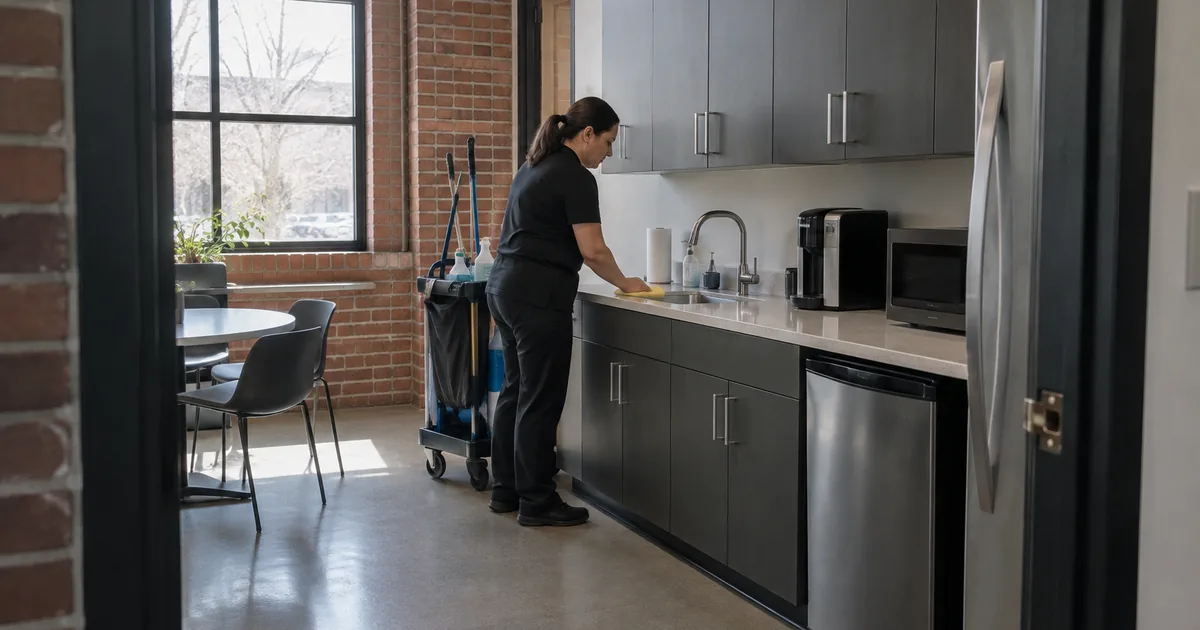
Breakrooms combine food residue, shared touchpoints, and personal property. Define routine care for accessible counters, sinks, tables, floors, waste containers, and agreed appliance exteriors. Decide who removes food, washes dishes, and clears counters. A cleaner should not have to guess whether an unlabeled container can be discarded.
Cabinet and appliance interiors need explicit scope language. For a deep-clean service, appliance interiors and inside cabinets are optional add-ons, not automatic inclusions. Move-In/Move-Out service includes inside and outside cabinets and appliances. For office janitorial planning, record exactly which interior tasks are authorized rather than importing assumptions from another service category.
For example, a shared refrigerator might receive exterior attention during routine visits, while interior cleaning is separately approved after employees remove food. Ask who empties it, who authorizes disposal, and whether manufacturer instructions affect the method. Interior windows are optional for all services except Airbnb turnovers; discuss office interior windows as a separate option rather than assuming they accompany breakroom or general room cleaning.
Match floors and surfaces to appropriate methods
Record surface materials during the walkthrough, especially natural stone, wood, resilient flooring, glass, and coated fixtures. Cleaning should follow manufacturer-safe surface care rather than using one product throughout the office. Never mix cleaners, and avoid acidic products on stone. If a finish or material is uncertain, clarify the approved method before proceeding.
Routine floor care should address accessible traffic areas and ordinary tracked-in soil. Periodic attention can target accessible edges or other identified buildup, but specialized floor treatments require a separate discussion. Do not describe cleaning as restoration or assume damaged finishes can be corrected through additional scrubbing.
Disinfection is appropriate only where the situation and approved product support it. Surfaces may need cleaning first, and the disinfectant must remain wet for its full label contact time. A quick spray-and-wipe should not be represented as disinfection. Ask which touchpoints warrant that process and whether access restrictions allow the required application, contact time, and any label-directed follow-up before people use the surface again.
Prepare the information needed before commercial pricing
Commercial and industrial cleaning, including commercial post-construction cleaning, require a free in-person walkthrough before pricing. Provide the business name, approximate square footage, restroom count, preferred date and time window, and onsite contact. Include the exact Rock Hill office address, suite information, and entry instructions so the visit reaches the correct space.
Use the walkthrough to show restricted areas, busy rooms, waste arrangements, surface concerns, and storage limitations. Explain whether staff remain onsite during cleaning and whether alarms, keys, elevators, or locked doors affect access. These details help define workable responsibilities without guessing from square footage alone.
For commercial post-construction requests, identify remaining contractor activity and the type of visible debris. Hazardous work is never promised; unfamiliar materials or unsafe conditions require assessment rather than automatic inclusion. Prime Cleaning MO LLC’s standard/recurring service is available only after an initial deep clean, not as a first-time or one-time standard service. The first standard/recurring quote includes that deep clean; clarify the separately assessed commercial scope during the walkthrough.
Review results and adjust periodic tasks deliberately
Keep the agreed room list and task schedule available to the office contact and cleaning team. After visits, evaluate the specified outcomes rather than adding unspoken expectations. If a meeting table was covered with documents, note the access issue and arrange a clear surface next time instead of treating inaccessible space as an agreed cleaning opportunity.
Review periodic work separately from routine maintenance. Ask whether buildup appears before the next planned inspection, whether certain rooms are used less often, and whether a staffing change has increased restroom or breakroom demand. Adjust the relevant task rather than automatically increasing everything.
For example, increased conference-room bookings may justify more frequent table and floor attention without changing storage-room dusting. Conversely, a seldom-used room may still need periodic inspection for accumulated dust. Record approved changes, the areas affected, and any access preparation. This keeps the plan responsive while preserving the distinction between routine upkeep, scheduled periodic work, and separately authorized requests.