Commercial & Janitorial
Office Janitorial Cleaning St. Charles: The Initial Deep-Clean Baseline
Build an office janitorial plan around a documented initial deep clean, room-specific priorities, and a walkthrough-based scope before recurring maintenance begins.
office janitorial cleaning St. Charles: The Initial Deep-Clean Baseline
For office janitorial cleaning St. Charles businesses can plan around, start by documenting the building’s condition rather than selecting a frequency alone. An office with dusty partition ledges, buildup around restroom fixtures, and crumbs beneath breakroom furniture needs a different starting scope from an office already maintained consistently. Prime Cleaning MO LLC requires an initial deep clean before standard or recurring service, and the first recurring quote includes that deep clean.
Treat this baseline as a written agreement about accessible rooms, priority surfaces, existing buildup, and exclusions. Identify areas that need extra attention before maintenance starts, then distinguish those tasks from repeat visits. Record preexisting damage separately so a stained ceiling tile or scratched floor does not become an implied cleaning obligation. The goal is an agreed starting condition, not a promise that every surface can be restored.
Arrange the walkthrough before discussing pricing
Commercial, industrial, and commercial post-construction cleaning require a free in-person walkthrough before pricing from Prime Cleaning MO LLC. To arrange it, provide the business name, approximate square footage, restroom count, preferred date and time window, and an onsite contact. Also explain whether the space is occupied, undergoing work, or preparing to reopen; those conditions change access and the proposed scope.
Walk the actual cleaning route with someone who can authorize access. Open representative offices, show supply storage, identify restricted rooms, and point out floor transitions. Ask whether the quoted square footage includes warehouse areas, shared corridors, or spaces maintained by the property manager. That prevents the same area from being assumed into two different contracts.
Before the visit ends, confirm who supplies consumables, where approved waste goes, and which doors need to remain secured. Pricing should follow the observed conditions and agreed responsibilities, not square footage alone.
Explore our commercial & janitorial service and cleaning in St. Charles, MO for property-specific information.
Divide the office into rooms with different needs
A single building-wide frequency can hide important differences. Map rooms by use, occupancy, surface type, and access restrictions. For each zone, name the tasks, proposed frequency, responsible party, and conditions that trigger extra attention. A room list is more useful than an undefined promise to clean the whole office.
Reception, meeting rooms, and work areas
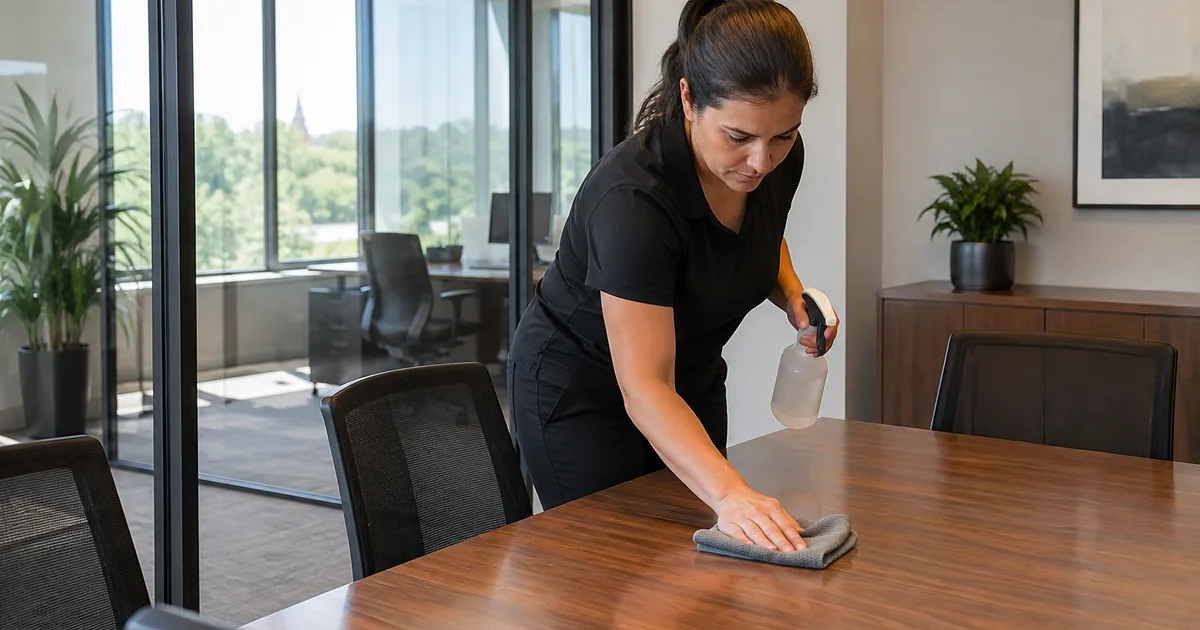
Reception needs attention to tracked debris, entry glass within the agreed scope, and frequently touched surfaces. Meeting rooms may need checks around scheduled gatherings rather than only on quiet evenings. At desks, establish a clear-surface rule: staff secure paperwork and personal items, while the cleaning scope identifies accessible surfaces. Ask whether keyboards, screens, desk phones, or shared equipment are included; do not assume they are.
Restrooms, breakrooms, and support spaces
Restroom planning should account for fixture count and actual use, not just room size. Breakrooms need separate decisions for counters, sinks, tables, flooring, and appliances. Supply closets, copy rooms, and archive areas may need less frequent scheduled attention, but blocked access or sensitive records should be resolved before those tasks enter the maintenance plan.
Set frequencies from use rather than habit
Choose frequencies by asking what happens between visits. How many people use the restroom? Do employees eat at desks? Does the entrance collect grit during wet weather? Are conference rooms booked back to back? Use these answers to create an initial schedule, then review observed conditions instead of assuming every office needs identical service.
For example, a lightly occupied administrative suite might need less frequent workstation dusting while still requiring regular restroom and breakroom attention. An office with rotating visitors may need entry floors and reception touchpoints checked more often than private offices. These are planning examples, not automatic service recommendations; the walkthrough determines what is reasonable.
Separate routine tasks from periodic ones. Waste removal and restroom care may belong on frequent visits, while accessible high dusting or detailed edge cleaning may follow a different interval. Define who handles spills or urgent messes between scheduled visits so the plan does not leave an operational gap.
Document what the initial deep clean includes
The initial deep-clean scope should identify the buildup being addressed and the surfaces staff can safely reach. Discuss accessible ledges, baseboards, door edges, restroom fixtures, breakroom surfaces, and floor edges during the walkthrough. These are scope questions, not a universal checklist. Furniture movement, height limits, and delicate finishes need explicit decisions before work begins.
Deep-clean appliance interiors and inside cabinets are optional add-ons, not automatic inclusions. If the office refrigerator needs interior cleaning, agree on who removes food and whether it must remain operating. For cabinets, identify which ones can be emptied and accessed without disturbing supplies or confidential materials. Interior windows are also optional for office service and should be listed separately when requested.
Use dated notes or authorized photographs to distinguish cleanable buildup from wear and damage. Detailing beyond a deep clean may take more than one day, so do not compress that work into an assumed maintenance visit. Confirm any additional scope before authorizing it.
Specify safe surface care and clear exclusions
Manufacturer-safe surface care belongs in the plan, especially where one office contains stone counters, coated desks, resilient flooring, and electronic equipment. Share available care instructions and identify surfaces with special restrictions. Avoid acids on stone, never mix cleaners, and select methods suited to the material rather than using the same product everywhere.
Disinfect only when appropriate for the surface and circumstances. Where disinfection is included, the product must be suitable for that use and the full label contact time must be followed. Discuss how surfaces will remain available for that process without interrupting staff or exposing paperwork and equipment to unsuitable moisture.
Identify unknown residues, sharps, suspected mold, or other potentially hazardous conditions during the walkthrough and exclude them from routine assumptions. Hazardous work is never promised. Commercial post-construction areas also require a free in-person walkthrough before pricing; describe remaining debris and ongoing trades so ordinary office maintenance is not mistaken for construction cleanup.
Make recurring visits repeatable and accountable
Once the initial deep-clean baseline is documented, convert the approved scope into a room-by-room maintenance record. Each entry should state the task, frequency, access requirement, and exception procedure. This keeps recurring janitorial work tied to the agreed starting condition instead of gradually expanding through informal requests.
Name one office contact who can approve changes and receive service notes. Establish a process for locked rooms, occupied meetings, inaccessible desks, and depleted consumables. If a room cannot be entered, record that exception and decide whether it should be addressed on a later visit or through separately approved work.
Use observable checks rather than vague ratings. Confirm whether accessible waste containers were emptied, agreed restroom fixtures were addressed, and specified floors were cleaned. Ask staff to report the room, surface, and issue rather than simply saying an area was missed. Never include confidential documents or employee details in photographs used for service communication.
Review the plan when office conditions change
Revisit the room map when staffing, visitor traffic, working hours, or office layout changes. A previously quiet meeting room used for daily training can create new waste, restroom demand, and breakroom traffic. Adjust the affected tasks rather than automatically increasing every room’s frequency.
Before approving a revision, ask whether the issue is frequency, scope, access, or a new condition. Recurring crumbs beneath an inaccessible desk call for an access discussion; buildup outside the agreed tasks calls for a scope decision. Record the approved change and any pricing implications before treating it as routine.
A practical request to Prime Cleaning MO LLC should summarize the office’s priorities, include the required walkthrough details, and ask for a documented initial deep-clean baseline followed by recurring maintenance. Keep the approved scope available to the onsite contact so future decisions have a clear reference.