Commercial & Janitorial
Office Janitorial Cleaning St. Peters: Electronics and No-Touch Zones
Build an office janitorial plan around room use, equipment sensitivity and clear access rules—not a generic checklist. Learn what to define before requesting pricing.
office janitorial cleaning St. Peters: Electronics and No-Touch Zones
Planning office janitorial cleaning St. Peters starts with understanding how your workplace operates, not assigning the same cleaning frequency to every room. A reception area, shared kitchen and server closet have different needs. For Prime Cleaning MO LLC, a useful commercial scope identifies what can be cleaned, what must remain untouched and who can authorize exceptions. The goal is a practical agreement that protects equipment while addressing everyday soil.
Prepared by the Prime Cleaning MO Team, this guide helps office managers organize room priorities and access instructions before requesting pricing. Start with a floor plan or simple room list. Mark occupied desks, shared touchpoints, restricted doors and sensitive equipment. Ask department leads which areas cannot be disturbed. Your exact St. Peters office address, suite and building entry instructions provide more useful planning context than assumptions about nearby businesses.
Prepare for an office janitorial cleaning St. Peters walkthrough
Commercial and industrial cleaning, including commercial post-construction work, requires a free in-person walkthrough before pricing. Provide the business name, approximate square footage, restroom count, preferred date and time window, and onsite contact. Include the exact office address and any check-in requirement so the visit can focus on scope rather than locating the correct entrance.
During the walkthrough, explain occupancy patterns rather than just headcount. Does one department work remotely while another shares desks? Are clients regularly seated in reception? Does a training room stay empty most days but host catered meetings? These differences help determine where routine attention belongs.
Identify existing surface damage, loose cables, unusual residues and areas excluded by building management. Ask who supplies consumables and whether waste goes to a shared collection point. If renovation dust or an unidentified spill is present, flag it separately. Do not assume ordinary janitorial service covers hazardous materials, equipment repair or specialized remediation.
Explore our commercial & janitorial service and cleaning in St. Peters, MO for property-specific information.
Set room frequencies from actual use
Create a room schedule with three fields: the cleaning task, the trigger or frequency, and the responsible party. Distinguish a routine cleaning visit from an employee response to a spill. Spills that present a slip risk should not wait for the next scheduled service. Review the schedule when attendance, tenants or room functions change.
Reception, corridors and meeting rooms
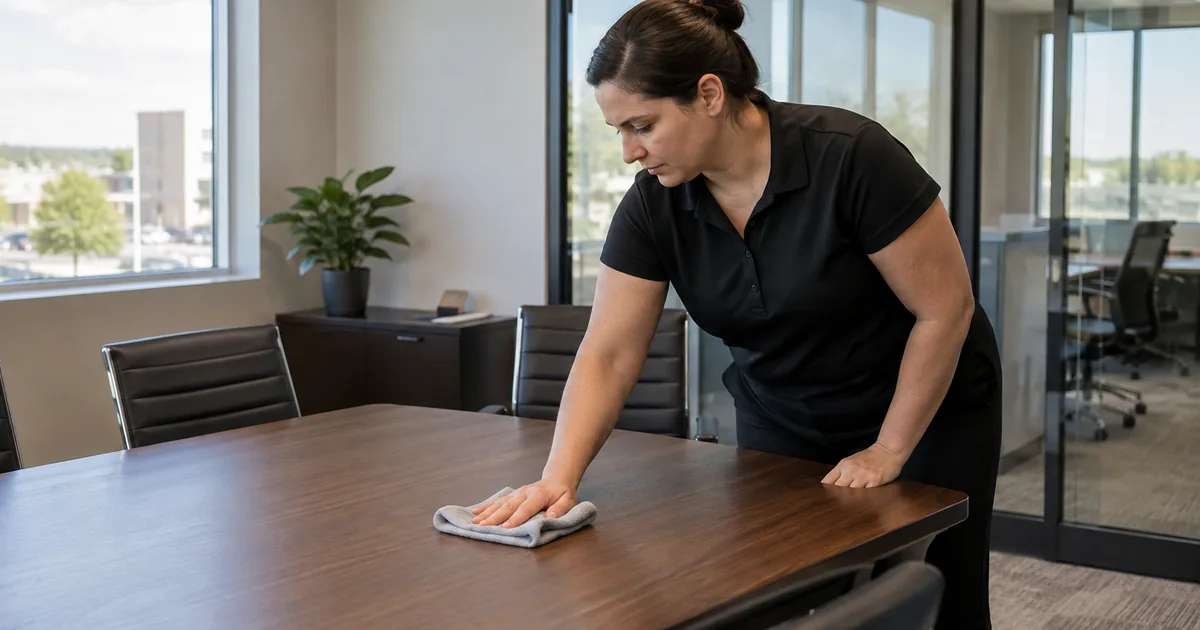
For a client-facing reception area, inspect visible debris and entrance soil each occupied day. The agreed cleaning frequency should reflect what those inspections reveal. Corridors near entrances may need more attention than quiet internal hallways. Schedule meeting-room attention around use: a heavily booked room may need frequent table and floor care, while an unused room may not need identical treatment.
Restrooms, kitchens and private offices
Restrooms and kitchens deserve priority because moisture, food residue and shared contact points accumulate differently from desk dust. Review them on occupied days and adjust service accordingly. Private offices with limited use may justify less frequent floor and accessible-surface cleaning. Ask whether personal dishes, food disposal and refrigerator contents remain employee responsibilities.
Protect electronics with explicit cleaning boundaries
Treat electronics as a separate scope decision, not ordinary furniture. Identify monitors, docking stations, keyboards, printers, conference controls and charging stations during the walkthrough. An agreement to clean a desk does not automatically authorize cleaning every device sitting on it. Record whether equipment exteriors are included and which manufacturer instructions govern care.
Never spray cleaning liquid directly onto electronics or allow moisture into vents, ports or seams. If equipment care is authorized, use the manufacturer-approved method and products, applying product to a cloth only where the instructions permit. Do not unplug, power down, move or reconnect equipment without explicit authorization. A cable that looks unused may support an active workstation or phone.
For example, staff can leave an accessible desk perimeter while keeping a connected laptop and dock untouched. Cleaning can then focus on the approved surface without lifting devices. If dust is trapped behind a complicated cable arrangement, ask the office contact to arrange access rather than improvising.
Define no-touch zones before the first visit
No-touch zones should be specific enough that a cleaner does not have to guess. Examples include document stacks, whiteboards with active project notes, medication storage, laboratory equipment, server racks and unlocked filing areas. Decide whether each restriction applies to an object, a surface or the entire room. A restricted desktop does not necessarily exclude the accessible floor beneath it.
Use a written room map and discreet, agreed labels where appropriate. Keep sensitive information out of the cleaning instructions: identify the restricted cabinet by location rather than describing its contents. Assign one authorized contact to resolve uncertainty. If that person is unavailable, the default should be to leave the uncertain item untouched and report the limitation.
Ask concrete questions: May chairs be moved? Are wastebaskets near shredders ordinary trash or confidential disposal? Can doors be opened after hours? Should cleaning pause during calls? A short exception log helps prevent the same unanswered access question from recurring.
Match surface care to materials and task
List surface materials where they affect product selection: natural stone counters, coated desks, glass partitions, stainless fixtures and specialty flooring. Use manufacturer-safe care rather than assuming one cleaner suits everything. Avoid acids on stone, and never mix cleaners. If a finish or residue is uncertain, identify it before choosing a treatment.
Separate routine soil removal from disinfection. Disinfect only when appropriate for the setting, surface and agreed scope. Follow the product label, including precleaning requirements, ventilation precautions and the full contact time. A quick wipe that dries too early does not meet a disinfectant's required wet contact time. Electronics also require compatibility checks; their presence does not justify applying an unsuitable disinfectant.
For a stone kitchenette counter, the decision begins with stone-compatible cleaning, not the strongest available chemical. For shared door hardware, appropriate disinfection may be included after cleaning. Staining, worn finishes or adhesive damage should be documented without promising restoration through ordinary janitorial work.
Separate routine tasks from optional and specialized work
Write down inclusions and exclusions room by room. For an office kitchen, distinguish appliance exteriors from interiors and cabinet fronts from cabinet interiors. Do not let the phrase “kitchen cleaning” carry all those meanings. Interior windows are optional for office services and should be requested explicitly, with access limitations discussed during the walkthrough.
If discussing a deep-clean service, appliance interiors and inside cabinets are optional add-ons. Move-In/Move-Out service includes inside and outside cabinets and appliances. Standard/recurring service is available only after an initial deep clean, not as a one-time or first-time service; the first standard/recurring quote includes that deep clean. Confirm the applicable service category rather than treating these names as interchangeable office packages.
Detailing beyond deep cleaning may take more than one day. Commercial post-construction scope still needs a free in-person walkthrough before pricing. Identify construction residue and access restrictions separately, and never assume hazardous work is included or can be accepted.
Make access, feedback and schedule changes manageable
Before service begins, confirm the entry method, alarm procedure, permitted work areas and closing responsibilities with the authorized office contact. Avoid circulating access codes through a broadly shared cleaning checklist. Discuss building rules for elevators, loading access and waste disposal, along with areas that must remain available to staff during cleaning.
Use a short feedback record that names the room, observed issue and requested clarification. “Conference table perimeter was inaccessible because equipment remained connected” is more useful than “meeting room missed.” It distinguishes a scope or access problem from a cleaning concern and gives the office a concrete next step.
Review frequencies against actual conditions. If the kitchen repeatedly needs attention between visits, consider adjusting service or assigning staff interim tasks. If a room remains unused, reassess its schedule without reducing attention elsewhere automatically. Bring the updated room list and no-touch map to Prime Cleaning MO LLC so proposed changes can be evaluated against the agreed commercial scope.