Commercial & Janitorial
Office Janitorial Cleaning Webster Groves: Caring for Mixed Floor Materials
Build a practical office cleaning scope around room use, mixed flooring, access needs and clear frequency decisions before requesting commercial pricing.
office janitorial cleaning Webster Groves: Caring for Mixed Floor Materials
Planning office janitorial cleaning Webster Groves starts with understanding how your workplace actually operates. A reception area, private office and shared restroom can require different attention even when their floor areas are similar. For your Webster Groves office, list every room, its flooring and its users before choosing visit frequencies. Prime Cleaning MO LLC can use that information during the required commercial walkthrough to discuss an appropriate scope.
Create a simple room register with columns for use, surface material, traffic, access restrictions and recurring concerns. Include overlooked transition spaces such as corridors, copier stations and the route between a breakroom and meeting rooms. Note where food travels, chairs roll and visitors enter.
Then identify responsibilities already assigned to staff or building management. Who removes cardboard, reports spills, replaces restroom supplies or maintains entry mats? Separating those duties prevents a cleaning plan from depending on work nobody has agreed to perform. Treat this register as a starting point, not a universal checklist.
Match cleaning frequency to room use
Choose frequencies by observable conditions rather than giving every room the same schedule. A restroom serving employees and visitors may need more frequent attention than a rarely used conference room. A breakroom used for meals needs different handling from a kitchenette used mainly for coffee. Ask when each room becomes noticeably soiled and whether that happens between proposed visits.
Build three frequency groups: tasks needed each scheduled visit, tasks performed periodically and tasks triggered by an event. Restroom servicing and removal of food-related waste may belong in the first group. Accessible ledge dusting may be periodic. A catered meeting or tracked-in moisture can create an additional need that should be reported rather than assumed covered.
For example, if a meeting room is occupied only occasionally, prioritize cleaning around bookings instead of copying the reception schedule. If entrance grit reaches adjacent carpet before the next visit, reconsider mat maintenance and entrance cleaning frequency. Confirm who handles urgent spills when the cleaning team is not onsite.
Explore our commercial & janitorial service and cleaning in Webster Groves, MO for property-specific information.
Identify mixed flooring before choosing products
Mixed flooring needs a material-specific plan. Record the floor type in each room, including any known finish, coating or manufacturer instructions. A stone lobby, resilient corridor and carpeted office should not automatically receive the same product or equipment settings. When material identification is uncertain, confirm it with the property manager before selecting a treatment.
Separate resilient flooring, wood and laminate
For vinyl, linoleum, laminate and wood, follow the applicable manufacturer guidance for cleaner compatibility, dilution and moisture. Similar-looking floors can have different requirements. Avoid assuming that steam, heavy wet mopping or aggressive pads are suitable. Discuss worn seams, lifted edges and damaged finishes during the walkthrough so cleaning methods do not add avoidable moisture or abrasion.
Distinguish stone, tile and carpet
Avoid acidic cleaners on stone, and verify compatibility with grout, sealers and surrounding finishes. Tile does not establish that every adjoining surface tolerates the same chemistry. For carpet, discuss routine vacuuming separately from spot treatment or any deeper service. Flag loose edges and existing stains; cleaning should not be presented as restoration or a promise to reverse permanent damage.
Control grit and moisture at floor transitions
Entrances deserve attention because soil moves beyond the doorway. Map the path from entry mats to hard flooring and carpet, noting where grit accumulates or moisture appears. Mat placement must preserve safe access and door clearance. Agree on who maintains mats and who responds when weather or a spill leaves a walking surface wet between visits.
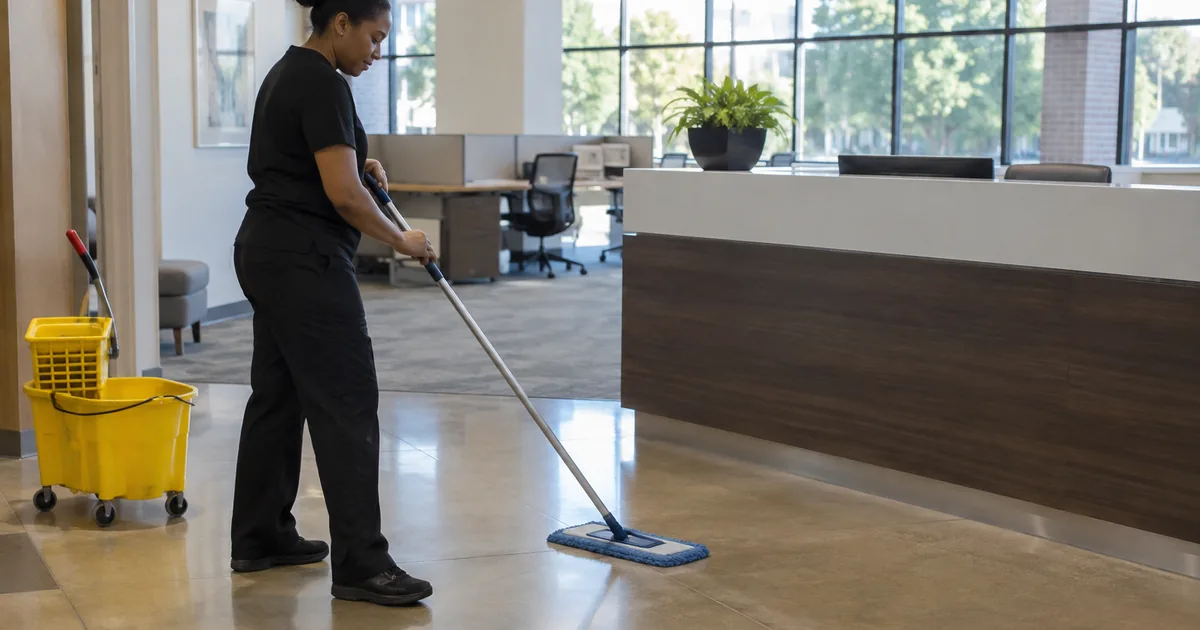
Use a sequence that removes loose soil before damp cleaning. Select tools and products for each surface rather than carrying a single wet mop through the entire office. Keep restroom tools separate from breakroom and general-office tools. Plan work so occupants do not have to cross freshly cleaned floors, and use appropriate wet-floor warnings while surfaces remain wet.
A practical decision example is a tiled entrance beside carpet: address grit at the entrance before it is carried into carpet fibers, then use controlled moisture on the tile according to its care instructions. If the floor stays sticky after cleaning, investigate residue, dilution and the existing finish rather than automatically increasing chemical strength.
Define restroom, breakroom and touchpoint work
Write restroom scope in terms of actual fixtures and supplies: toilets, urinals where present, sinks, counters, mirrors, dispensers and floors. Clarify whether the office supplies paper products and soap, whether replenishment is included, and where stock is stored. Report leaks, broken dispensers and damaged surfaces instead of treating maintenance problems as ordinary cleaning tasks.
For breakrooms, distinguish accessible counters, sinks, tables and appliance exteriors from interior appliance work. Ask who removes food, washes dishes and clears counters. Specify whether refrigerator shelves, microwave interiors or cabinet interiors are requested; their presence in a room does not make them automatically included. Do not discard employees’ food or belongings without an agreed policy.
Identify shared touchpoints such as door handles and meeting-room controls, but disinfect only when appropriate for the setting and surface. Cleaning and disinfection are separate decisions. Follow product directions, including the full label contact time, and never mix cleaners. Electronics require compatible manufacturer-approved methods; spraying liquid directly onto devices should not be assumed acceptable.
Set access rules and boundaries before service
An office cleaning plan needs workable access, not just a task list. Confirm the entry procedure, alarm instructions, authorized work areas and lockup responsibilities. Decide whether cleaning happens while employees are present or when rooms are vacant. Identify spaces requiring an escort, including records storage or offices containing confidential material.
Agree on a clear-desk boundary. Staff can remove personal items and secure documents before scheduled service; cleaners should not be expected to sort paperwork, disconnect equipment or open drawers without authorization. Discuss cords, rolling chairs and movable furniture so floor access does not depend on improvised handling of sensitive equipment.
Set an escalation process for unexpected conditions. A suspicious substance, sharps, significant water intrusion or other potentially hazardous condition needs notification and assessment, not a promise of routine cleanup. Hazardous work is not promised. Likewise, heavy buildup or detailing beyond deep-clean scope may take more than one day; assess access and extent before assuming a single visit will cover it.
Prepare for the required in-person walkthrough
Prime Cleaning MO LLC requires a free in-person walkthrough before pricing commercial or industrial cleaning, including commercial post-construction work. Prepare your business name, approximate square footage, restroom count, preferred date and time window, and onsite contact. These details help organize the visit, but they do not replace seeing the property.
During the walkthrough, point out every floor material, damaged area, restricted room and recurring trouble spot. Ask which tasks belong in each visit, which need a separate frequency and which fall outside the proposed scope. Confirm supply responsibilities, waste collection points and access to water and storage. For post-construction conditions, identify remaining debris and active work areas without assuming all materials can be safely handled.
Keep service categories distinct. Standard/recurring service is available only after an initial deep clean, and its first quote includes that deep clean; it is not a one-time or first-time option. Discuss the commercial janitorial proposal separately rather than assuming a residential service label establishes the office scope.
Review results and adjust the written plan
After service begins, review outcomes against agreed tasks rather than an undefined expectation that everything should look new. Check representative areas: entrance grit, restroom supplies, breakroom residue and floor transitions. Separate a missed cleaning task from a damaged finish, maintenance problem or new spill. That distinction supports a useful correction.
Keep feedback specific: name the room, surface and condition, and note whether it appeared before or after occupancy. Revisit frequencies when staffing, visitors, room use or weather-related tracking changes. A previously quiet office may need different attention after becoming a shared meeting space.
Document additions explicitly. Appliance interiors and inside cabinets are optional deep-clean add-ons; move-in/move-out service includes inside and outside cabinets and appliances. Interior windows are optional for all services except Airbnb turnovers. For this office, specify any window work, appliance interiors or cabinet interiors in the commercial agreement rather than relying on assumptions from another service. A clear plan makes both routine work and changes easier to assess.